<?xml version="1.0" encoding="UTF-8"?>
<feed xmlns="http://www.w3.org/2005/Atom">
  <title type="text">Paris City &amp;amp; Civ</title>
  <updated>2026-03-04T21:28:18+00:00</updated>
  <generator uri="http://framework.zend.com" version="1.12.20">Zend_Feed_Writer</generator>
  <link rel="alternate" type="text/html" href="https://paris.cityandciv.com/"/>
  <link rel="self" type="application/atom+xml" href="https://paris.cityandciv.com/items/browse?output=rss2"/>
  <id>https://paris.cityandciv.com/</id>
  <author>
    <name>Paris City &amp;amp; Civ</name>
    <uri>https://paris.cityandciv.com</uri>
  </author>
  <link rel="hub" href="https://pubsubhubbub.appspot.com/"/>
  <entry>
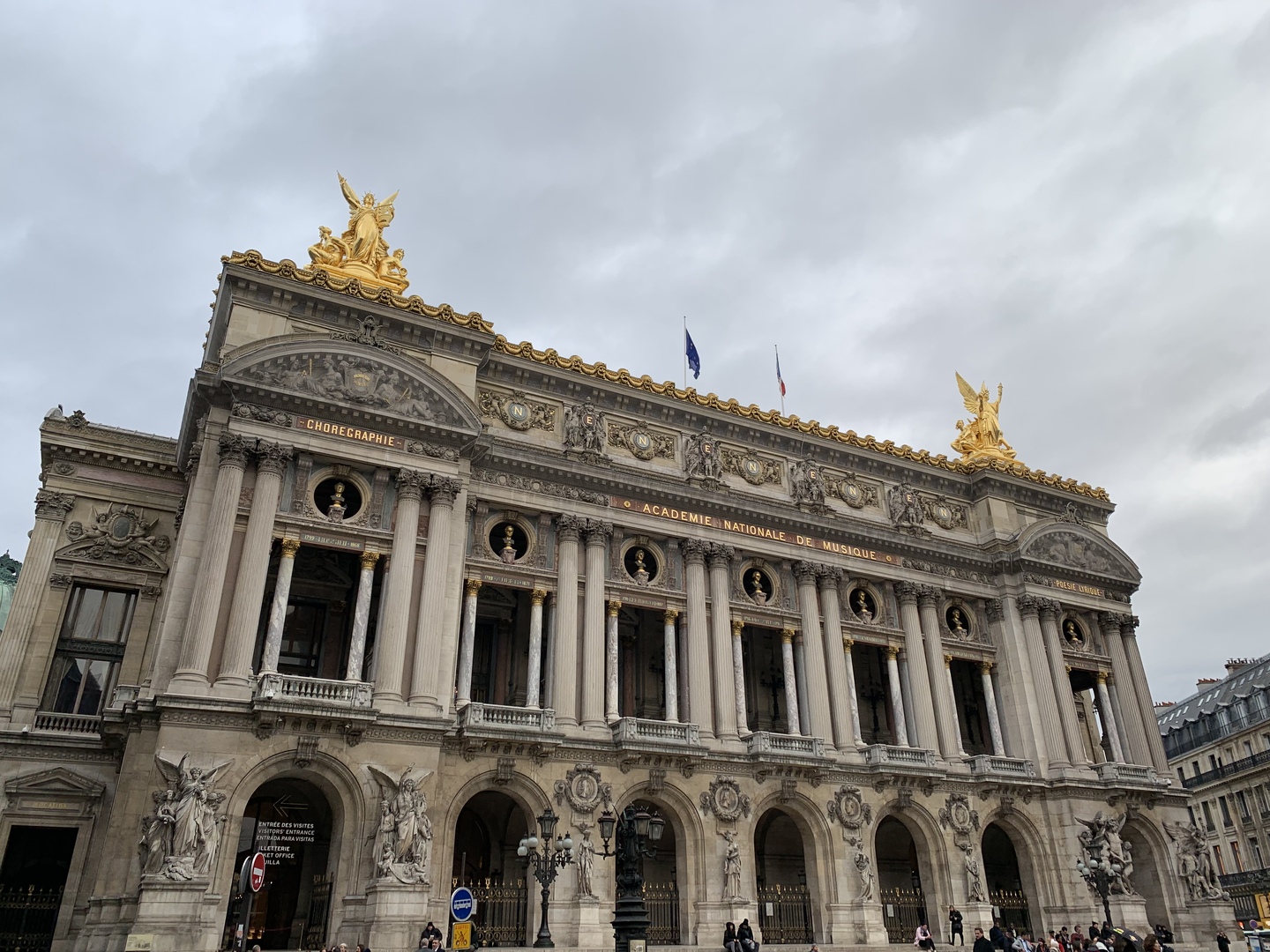
    <title type="html"><![CDATA[The Facade of Palais Garnier<br />
: The Extravagant and Theatrical Facade of Palais Garnier<br />
]]></title>
    <summary type="html"><![CDATA[<p><strong><em>Palais Garnier, also known as the Opéra Garnier, stands as one of the top monuments in Paris holding itself up alongside the Louvre, the Tour Eiffel and L’Arc de Triomphe.  It is known as one of the most lavish buildings as well as being the inspiration for Gaston Leroux’s 1910 novel The Phantom of the Opera.  Stepping out of the Opéra metro stop and coming face-to-face with the Palais facade is a breathtaking experience. </em></strong></p><img src="https://paris.cityandciv.com/files/fullsize/b587b1bac590b1997bde084781a971d1.jpg" alt="Palais Garnier Facade" /><br/><p>Located in the theater district that runs through the ninth arrondissement of Paris stands the luxurious building known as Palais Garnier.  The location of the Opéra house was dictated by Baron Haussmann, who played a large part in the urban renewal of Paris which included the construction of new parks, streets, and buildings.  The production of the building started in 1861 and took fifteen years to complete.  In 1867, despite the building still being under construction, an event was held to inaugurate only the facade of the Palais.  The inauguration for the completion of the entire building was held on January 5, 1875, and there were almost two thousand people in attendance from all over Europe. </p><p>The namesake for Opéra Garnier, Charles Garnier, was a designer and an architect who won the prize of a lifetime in a competition held for the design rights of this building.  In 1860 a call for design submissions for the future opera house was held and in 1861 the contest came to a close with Charles Garnier as its champion. Garnier designed the building using a blend of different architectural styles that came together as the Napoleon III style.  This involves elements of Baroque revival architecture, which is also known as Neo-Baroque, Second Empire architecture, which is exemplified by elaborate ornamentation, and Beaux-arts architecture.  Second Empire style of architecture evolved into Baroque revival, and Beaux-arts style drew upon French neoclassical with gothic elements.  This style drew upon Greek and Roman architectural characteristics, such as the creation of massive buildings with a symmetrical façade, decorated columns, and archways.  Characteristic of this new, at the time, Napoleon III architectural style was to leave no space without decoration.  This can be seen in the heavy ornamentation on every aspect of the building.  Sculptures are placed in the spaces between arches and the columns are of Corinthian style, which is the most decorative order to use.  Along the roof of the facade are gilded bronze faces that represent comic and tragic antique masks, which are used as symbols to represent the theater. </p><p>A great deal of work was put into the facade including work from fourteen painters and seventy-three sculptors and a variety of material, including gilded bronze, marble, and stone were used in its creation.  It is very theatrical architecture for a very theatrical building.  Placed within the faꞔade are bronze busts of some of the world’s greatest composers, including Beethoven and Mozart.  Below these heads are relief sculptures of other composers including Bach and Pergolesi.  The faꞔade also includes a variety of statues, as well as low relief and high relief sculpting.  Two gilded figures on the roof, known as Harmony on the left and Poetry on the right, were created by French sculptor Charles Gumery and exemplify perfectly the opulence of the second empire architectural style.  The tallest point of the building is a statue of Apollo created by Aimé Millet, a French sculptor, making the building one-hundred and eighty-four feet tall, which is only fifty-five feet taller than the Jefferson Memorial building in Washington D.C.  Today Opéra Garnier primarily functions as a theater for ballet events. </p><p><em><strong><a href="https://paris.cityandciv.com/items/show/23">For more (including 6 images) view the original article</a></strong></em></p>]]></summary>
    <published>2019-05-10T00:41:17+00:00</published>
    <updated>2026-03-04T21:28:18+00:00</updated>
    <link rel="alternate" type="text/html" href="https://paris.cityandciv.com/items/show/23"/>
    <id>https://paris.cityandciv.com/items/show/23</id>
    <author>
      <name>Mariah Workman</name>
    </author>
  </entry>
  <entry>
    <title type="html"><![CDATA[Charles Garnier &amp; the Palais Garnier: A competition to create one of Paris&#039; most iconic opera houses with obstacles including war, a ravaging fire, and a designer&#039;s dream to fulfill the extravagant wishes of the rich while doing so in an extremely short period of time. This is Charles Garnier&#039;s life and his ultimate masterpiece — The Palais Garnier.]]></title>
    <summary type="html"><![CDATA[<p><strong><em>Paris in the 1800s was a time of grand historical figures, disputes of religion, the call of revolution, and, of course, extravagant architecture. As many Parisians believed during this time, “there is no hesitation to be had between the arts. One must be God, or else an architect.” These exact words were spoken by one of the most famous Parisian architects in the 19th century, Charles Garnier.</em></strong></p><img src="https://paris.cityandciv.com/files/fullsize/f565124a3b4bbd8d359b17b5596a4d86.jpg" alt="Paris Opéra House (Palais Garnier)" /><br/><p>Garnier was born into a working-class family that lived in one of Paris’ most exciting neighborhoods, Rue Mouffetard. He was always fascinated by architecture, even as a young child, and remained a student of the works of Greek and Ancient Roman architects from his teenage years and beyond. </p><p>He won the title of multiple prestigious honors during his earlier years, including a fellowship in Rome at the Villa Medici, but it was not until the coveted Opéra competition that Garnier would come to be known as the Charles Garnier. </p><p>Garnier was a very competitive man. The first design he submitted for the Palais ranked last out of the five finalists. After receiving this news, he proposed a companionship with Léon Ginain to create a combined design but was rebuffed by Ginain. In response to this, he worked day and night to create a new outline that would immediately enamor the judges, all by himself. And just a few months after his first initial submission, he did. </p><p>Construction on the Palais began almost immediately after Garnier’s design was picked. The team of architects and draftsmen that created the Palais included only ten men, including Garnier, himself. He was always considered a kind, giving man, but was always recognized as a hard worker, as well. He suffered bouts of depression throughout his life but always managed to help his workers through their more difficult times during the construction of the Palais. Garnier was also an acclaimed playwright and songwriter who love to dabble in the world of writing (when he wasn’t busy with creating one of Paris’ most famous sites, of course). </p><p>During a time when oil paintings were the only way of capturing a portrait, Garnier had a distinct look about him that made him extremely recognizable. So famous was his look, with messy, curled hair, a distinctively large nose, and a fashionable mustache that he was often spotted by people on the streets of Paris. The fact that he was also considered the most famous architect in France at this time also helped promote his credibility as an architect to an unknown level. </p><p>Construction on the Palais faced major setbacks. Events including the Franco-Prussian war, the fall of the Second French Empire, and the Paris Commune didn't help the builders' mission to complete the Palais in a timely manner. Other disasters in other parts of Paris also created major issues for Garnier.</p><p>After Salle le Peletier, the temporary home of the Paris Opéra, was destroyed by a ravaging fire in 1873, Garnier was <i>then</i> commissioned to create the new home of the Opéra house, which would be located inside the Palais Garnier. Faced with many technical setbacks and a numerous amount of difficulties in creating a glamorous, yet sensibly safe Opéra house for the people of Paris, Garnier went straight to work to design such an incredible feature, focusing on one area of the Palais in particular - the ceiling of the grand staircase. </p><p>Garnier turned to Isidore Pils to create the main attraction of his Opéra house. A grand ceiling with the scenes of mythological figures such as Apollo and Orpheus painted onto it became quite the challenge for Pils, who fell ill during the creation of his masterpiece. Pils’ two younger students took over the job and worked until the day before the Palais’ grand opening. </p><p>As night fell upon the Opéra house, Garnier, Pils, and the rest of the painters and architects came together to admire their tremendous feat of work. On the evening of January 5, 1875, people from all over France crowded around the Palais Garnier to get even just a glimpse of the new Opéra House. During the intermission of the first performance officially held at the new Opéra House, Garnier stood center stage, receiving a booming sound of applause and cheers from those in attendance. Completely taken aback with emotion, Garnier had finally received the recognition he had always deserved, standing in the center of the greatest achievement in his life, as an architecture, and a proud Parisian.</p><p><em><strong><a href="https://paris.cityandciv.com/items/show/8">For more (including 6 images) view the original article</a></strong></em></p>]]></summary>
    <published>2019-04-24T19:03:15+00:00</published>
    <updated>2026-03-04T21:28:17+00:00</updated>
    <link rel="alternate" type="text/html" href="https://paris.cityandciv.com/items/show/8"/>
    <id>https://paris.cityandciv.com/items/show/8</id>
    <author>
      <name>Amanda Chambers</name>
    </author>
  </entry>
</feed>
