<?xml version="1.0" encoding="UTF-8"?>
<feed xmlns="http://www.w3.org/2005/Atom">
  <title type="text">Paris City &amp;amp; Civ</title>
  <updated>2026-03-04T21:28:19+00:00</updated>
  <generator uri="http://framework.zend.com" version="1.12.20">Zend_Feed_Writer</generator>
  <link rel="alternate" type="text/html" href="https://paris.cityandciv.com/"/>
  <link rel="self" type="application/atom+xml" href="https://paris.cityandciv.com/items/browse?output=rss2"/>
  <id>https://paris.cityandciv.com/</id>
  <author>
    <name>Paris City &amp;amp; Civ</name>
    <uri>https://paris.cityandciv.com</uri>
  </author>
  <link rel="hub" href="https://pubsubhubbub.appspot.com/"/>
  <entry>
    <title type="html"><![CDATA[La Cimitière de Picpus: Lafayette, he is here!]]></title>
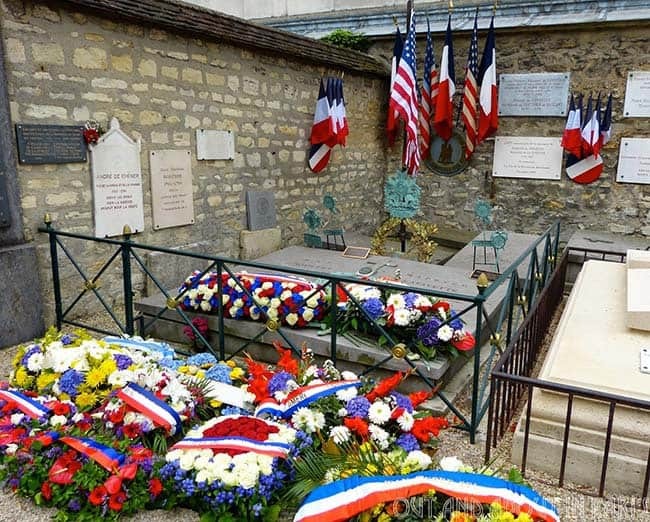
    <summary type="html"><![CDATA[<p><strong><em>A hero of the American Revolution, Gilbert du Motier, the Marquis de Lafayette, lies buried in Picpus Cemetery under American soil brought back from Bunker Hill.  His presence in this private cemetery, however, reflects a darker and lesser-known relationship with another revolution--that of his native France. </em></strong></p><img src="https://paris.cityandciv.com/files/fullsize/2424088a0ba9d4ba1dace61ae3a50346.jpg" alt="Lafayette&#039;s Tomb" /><br/><p>Lafayette was given the rank of Major General when he left France at age 19 to serve the cause of American independence alongside his mentor and spiritual father, George Washington. For his service, Lafayette not only earned the gratitude of the American people, he was also given honorary American citizenship and fêted with a year-long triumphant farewell tour of all 24 U.S. states in 1824. When he died in 1834, he was mourned by the entire nation. A bicentennial tour planned for 2024 will follow the same route as the 1824 tour, a reminder to Americans of the role that Lafayette played in securing our freedom. </p><p>An American flag flies over Lafayette's tomb at Picpus which is maintained by Daughters of the American Revolution. Each July 4th the flag is renewed in a ceremony that pays tribute to Lafayette and the friendship between our two nations. When American troops liberated Paris in July 1917, General Pershing sent Colonel Stanton to Lafayette's grave at Picpus where, in a stirring speech, he pronounced the famous words "Lafayette, we are here." It is said that the American flag remained flying over Lafayette's grave in Picpus during the occupation of Paris by the Nazis. These stories are well-known to many Americans, but the horrific history of Picpus may not be evident to the groups of Americans who visit the cemetery in Paris each year.</p><p>La Cimitière de Picpus is located near the current Place de la Nation. This square went by the name of the "La Place du Trône Renversé" (Square of the Overturned Throne) during the final bloody years of the French Revolution known as the "Reign of Terror." It was one of several sites in Paris where "enemies of the revolution" were guillotined--up to 55 executions per day. An estimated 16,000 to 40,000 people died during this dark period of French history. During the six-week period between June 17th and July 27, 1794, 1,306 people were guillotined in the square near Picpus. </p><p>With so many headless bodies rotting in the summer heat, and no space left to bury them in Paris, the government seized the land of a nearby convent, dug two enormous pits, and under cover of night, dumped the corpses into these mass graves after their names were recorded and their clothing and belongings inventoried. Among the dead were the sister, mother and aunt of Lafayette's wife, Adrienne. The victims came from all walks of life and included commoners, aristocrats, clergy, and sixteen Carmelite nuns who sang hymns as they were led to the guillotine platform. Known as "Les Martyres de Compiègne," their story inspired a novella, a motion picture, and an opera. </p><p>The Reign of Terror that Robespierre orchestrated finally ended with his beheading in this same square on July 29, 1794. France wanted to forget this horrific chapter in their past, but the families of the victims, including Lafayette's wife and sister-in-law, could not. They were among a number of families from Old Regime nobility who raised money to purchase the garden of Picpus in 1802 as a site of commemoration. They established a religious community charged with praying for the victims on the site and built a chapel where you can still see the names of all 1,306 victims recorded on the chapel wall. Burial in this private cemetery is strictly limited to families of these victims, which explains why the tombs of Lafayette and his wife are located there. After the French Revolution, Napoleon made all cemeteries public. Picpus is one of the rare exceptions and critics consider its establishment as anti-revolutionary since only the wealthy can afford to be buried in what is now a socially exclusive <em>lieu de mémoire.</em> </p><p>By the time Lafayette died in 1834, his considerable contributions to France--including <em>La Declaration des droits de l'homme et du citoyen</em>, which he drafted with help from Thomas Jefferson--were overshadowed by the king's fear of his influence. King Louis-Philippe put a ban on any official recognition for Lafayette and placed armed guards along the funeral route to keep French citizens away. Today, Americans and French alike can make the pilgrimage to Lafayette's tomb at Picpus Cemetery. Behind the cemetery walls, this "hero of two worlds" lies buried near the mass graves that contain more than a thousand headless bodies. Picpus is a stark reminder of the high cost of liberty and the revolutions on both sides of the Atlantic that called for sacrifices from people like Lafayette and others in order to secure it.</p><p><em><strong><a href="https://paris.cityandciv.com/items/show/63">For more (including 6 images) view the original article</a></strong></em></p>]]></summary>
    <published>2024-04-12T06:22:22+00:00</published>
    <updated>2026-03-04T21:28:19+00:00</updated>
    <link rel="alternate" type="text/html" href="https://paris.cityandciv.com/items/show/63"/>
    <id>https://paris.cityandciv.com/items/show/63</id>
    <author>
      <name>Tama Lea Engelking</name>
    </author>
  </entry>
  <entry>
    <title type="html"><![CDATA[Cimetière de Montmartre: Where bright minds and talent are laid to rest in a beautiful city.]]></title>
    <summary type="html"><![CDATA[<p><strong><em>In the city of Paris lies Montmartre, an area well known for its artistic history and young cultural crowd. In a city full of decades and decades of artists and bright minds, many who have passed have been laid to rest at the Montmarte Cemetery. The creative minds buried inside the cemetery walls have a significant impact on the history of the Cemetery. The cemetery provides visitors with a map marking all entrances and famous gravesites. You’ll find the sites of Degas, Dalida, Zola, Nijinsky, Gonzales, Berlioz, and many others. </em></strong></p><img src="https://paris.cityandciv.com/files/fullsize/60c1059ddbb9e4ea7770803c83907eab.jpg" alt="Cimetière de Montmartre" /><br/><p>The Montmartre Cemetery is known for housing bright and well-known creatives. Edgar Degas, a French artist famous for his drawings, paintings, prints, and sculptures is buried here. The gravesite of Degas, labeled “Famille de Gas” is a larger-than-life-size standing metal box fixed with an engraved sculpture of his face placed in the center facing visitors. Degas began his career in Paris and then studied classical art in Italy. After training in this way to be a traditional painter he switched courses to focus on the contemporary subject matter. After returning to Paris Degas joined the group later known as the Impressionists. Though he despised the term “impressionist” in association with his work, he has been recognized as one of the founders of Impressionist art. Throughout the end of his life, he became isolated, lost his eyesight, and ceased working. He spent the last 5 years of his life nearly blind and he wandered the streets of Paris up until his death in 1917.</p><p>Hector Berlioz, a Romantic composer and one of music’s greatest innovators also lies at Montmartre. He composed pieces including the Symphonie fantastique, Harold in Italy, the Requiem, and L’Efance du Christ, as well as the operas Benvenuto Cellini, Les Troyens, and Béatrice et Bénédict. Throughout his time he held romanticism in his art by emphasizing originality and individuality in the freedom and emotional expression in his work. He was often told by multiple teachers and friends time and time again that he was a genius and not meant to continue on his current path to becoming a doctor, but should instead become a composer. Berlioz's unrequited affection for actress Harriet Smithson was his inspiration for Symphonie fantastique (1830). After his failed pursued romance with Smithson, he was then engaged to Marie Moke. Upon learning she had broken their engagement to go wed another, he escaped to Rome armed with pistols, poison, and a disguise in order to kill the newlyweds and then himself. He returned to Paris realizing his absurd situation and pursued another and continued to write music with a passion. His impact on music was monumental and is still regarded as a genius composer. After his death, the French Government argued that his remains should be buried in the Pantheon among other influencers imperative to their nation’s culture. However, his dying wish was to be buried among his two wives in Montmartre. His wish was granted, as he was buried along with Degas and other creatives.</p><p>Another creative buried in the cemetery was French singer and actress, Dalida. Born in Eygpt as Yolanda Christina Gigliotti, she moved to Paris in 1956 under her stage name “Dalida”. After beginning to perform music she was awarded a Gold Record for a million in sales in 1957 for her song, “Bambino”. She earned over 70 Gold Records throughout her career and was the first woman to receive a Platinum Record in France. She then received a Lifetime Achievement and gained her French citizenship. After grieving her partner’s suicide in 1967, she in turn attempted suicide and lived through many health complications throughout her life. At the end of her career she died due to an overdose after another relationship had failed, she wrote "Life has become unbearable ... forgive me." A corner in Paris, of the rue Girardon and rue de l’Abreuvoie in Montemarte, was named “Place Dalida” and a sculpture was placed at the site. Her gravesite at the Montmartre Cemetery is one of the most beautiful, as it is surrounded by fresh flowers, a beautiful sculpture of herself, and framing structures. The gravesite of Dalida, and others like Degas and Berlioz, do what they can to represent and respect great creative influences in France’s history—as gravesites like these make the cemetery what it is.</p><p>Cemeteries are more than housed bodies, they are representations of the creativeness and bright minds of the city. Just because Degas, Berlioz, and Dalida’s physical presence came to an end in Paris, doesn’t mean their legacy ceases to live on.</p><p><em><strong><a href="https://paris.cityandciv.com/items/show/58">For more (including 6 images) view the original article</a></strong></em></p>]]></summary>
    <published>2022-04-25T18:56:08+00:00</published>
    <updated>2026-03-04T21:28:19+00:00</updated>
    <link rel="alternate" type="text/html" href="https://paris.cityandciv.com/items/show/58"/>
    <id>https://paris.cityandciv.com/items/show/58</id>
    <author>
      <name>Shannon Pipik</name>
    </author>
  </entry>
  <entry>
    <title type="html"><![CDATA[The Parisian Catacombs: Skeletons of a City]]></title>
    <summary type="html"><![CDATA[<p><strong><em>In a city where people come to live life to the fullest, a chilling reminder of mortality rests just beneath the surface.</em></strong></p><img src="https://paris.cityandciv.com/files/fullsize/2ad4d7ee8fd71f0e73ce87eda817a7ab.jpg" alt="Catacombes de Paris" /><br/><p>Paris is a city where one can enjoy most every aspect of life; from delightful meals, sunny afternoons, fulfilling conversation, thought-provoking art, scenic views, and a rich history to enjoy, time in Paris is indeed time well spent. With the history of Paris expanding back to the time of the Ancient Romans, there are many ghosts of the past that linger in the city today. These ghosts, whispers of those who were here before, are not always easily detected by the common eye. Still-standing structures such as bath houses, walls, and churches are more obvious examples. But those who are privy to a more intimate knowledge of the city are aware of a far more literal example of Paris’ ‘ghosts’. The Parisian Catacombs are located 20 metres below the primped and paved streets of Paris. At this depth, a constant cool temperature is maintained, ensuring visitors find the experience chilling in more than one way. The catacombs have a complicated history; the dark and disturbing installation was ironically created in order to promote the health and well-being of Parisian citizens. Try not to hold your breath as we descend into the unique and fascinating history of this hidden treasure of Paris.</p><p>A city with extensive history is a city with extensive graves. Corpses, bodies from times past, buried in multitudes within the city when the expansion of Paris to the extent seen today was inconceivable in comparison to the time periods of those buried. Problems began to arise when various weather conditions caused the spilling over of corpses onto now developed properties. This instance occurred in 1780 at Les Innocents, and pushed the government of Paris to do something to both fix and prevent the mess from happening again. Paris was already home to a sprawling expanse of over 800 hectares of tunnels beneath the city that were used for the extraction of building materials to aid in constructing the city. Cemeteries, specifically Les Innocents, began to be emptied into the tunnels in an orderly fashion around 1785-6.  The project ended up taking 12 years, and the body count amounted to over 6 million. Reaching almost as far back into Parisian history as can be traced, the oldest bones moved belonged to the Merovingians, a people who inhabited Paris after the Romans. The catacombs come back into play via the realization of a Haussmannian city during the reign of Napoleon IIId. It had been deemed the “Paris Municipal Ossuary” in 1768.  The movement of bones to the catacombs ended officially in 1860. They were complete with both bones of old and bones of new, including Revolutionary icons Jean-Paul Marat and Maximilien de Robespierre. The catacombs were a successful attempt at improving the health of the city and allowing neighborhoods to live without fear of bodies popping up onto their lawns. They also became a popular and unique symbol of Paris, and provide an unforgettable visitor experience.</p><p>Visitors to the catacombs will encounter a relatively uniform display of the skulls and bones that rest there. No one skull clearly belongs to another body. An effort seems to be made to keep the space organized and respectful, yet the bones are strewn carelessly behind the ordered facade of skulls. The air is still, and quarters are tight. You must walk carefully as to not brush against a bone of some sort. The sheer number of bodies that lie within the catacombs is difficult to comprehend. A cemetary seeks to hide death; it is what humans are comfortable with and used to. In the catacombs of Paris, death stares you right in the face. </p><p>So now, when walking the streets of Paris, don’t forget to look down; for more lies beneath than the eye can see!</p><p><em><strong><a href="https://paris.cityandciv.com/items/show/6">For more (including 5 images) view the original article</a></strong></em></p>]]></summary>
    <published>2019-04-24T04:59:54+00:00</published>
    <updated>2026-03-04T21:28:17+00:00</updated>
    <link rel="alternate" type="text/html" href="https://paris.cityandciv.com/items/show/6"/>
    <id>https://paris.cityandciv.com/items/show/6</id>
    <author>
      <name>Danielle Cooke</name>
    </author>
  </entry>
</feed>
