<?xml version="1.0" encoding="UTF-8"?>
<feed xmlns="http://www.w3.org/2005/Atom">
  <title type="text">Paris City &amp;amp; Civ</title>
  <updated>2026-03-04T21:28:18+00:00</updated>
  <generator uri="http://framework.zend.com" version="1.12.20">Zend_Feed_Writer</generator>
  <link rel="alternate" type="text/html" href="https://paris.cityandciv.com/"/>
  <link rel="self" type="application/atom+xml" href="https://paris.cityandciv.com/items/browse?output=rss2"/>
  <id>https://paris.cityandciv.com/</id>
  <author>
    <name>Paris City &amp;amp; Civ</name>
    <uri>https://paris.cityandciv.com</uri>
  </author>
  <link rel="hub" href="https://pubsubhubbub.appspot.com/"/>
  <entry>
    <title type="html"><![CDATA[Café de Flore: Literary Hub in Saint-Germain-des-Pres]]></title>
    <summary type="html"><![CDATA[<p><strong><em>Café de Flore: one of the oldest surviving literary cafés. Its hallowed walls are a testament to over one hundred years of knowledge, and creativity. Intelligent dreamers, banded together under the greenery of the Flore to influence their country and the world. During the 1880s, on the corner where Boulevard Saint Germain and Saint Benoit meet, the Café de Flore opened its doors. Flore comes from the Roman goddess Flora, who is the goddess of flowers and spring. You can see a statue of her across from the café. The glass-enclosed terrasse, red banquettes, mahogany tables as well as mirrored walls and tiled floors, remain relatively unchanged to this day. </em></strong></p><img src="https://paris.cityandciv.com/files/fullsize/67b7f8346cde64832de6b51bfc7dbfba.jpg" alt="Café de Flore in the 1900s" /><br/><p>          Today, you might see actors or other celebrities enjoying expensive beverages and desserts at the Café de Flore, but in the 19th and early 20th centuries, it was full of writers, artists, philosophers, and even prostitutes. These people didn’t have a regular workflow, thus the Café de Flore became their workspace. They worked and ate breakfast, chatted amongst friends over lunch, and then lunch became dinner. Many creative minds worked and ate together, contributing to the world from their terrasse view.</p><p>The author Charles Maurras penned his work Au signe de Flore in this space during the late 19th century, an influential book that promoted a right-wing political movement. The Café de Flore remained a haven for intellectuals during both World Wars. It was completely untouched by German occupation. Guillaume Apollinaire, a writer and founder of surrealism, found that haven. He and Andrew Salmon made the Café their own publishing house where they created the literary art magazine Les Soirées de Paris, championing cubism in its pages. Some say the word “surrealist” was invented in the large main floor room of the Café. Pablo Picasso also frequented the café. After the war, many intellectuals such as the existentialist Jean-Paul Sartre and Simone de Beauvoir continued to visit the Café. Though it is difficult to tell if he preferred the Flore to its rival across the boulevard, Les Deux Magots, Jean-Paul Sartre spent many days here, engaging in rigorous intellectual conversations. </p><p>The environment in the mid 20th century was social and robust. You can imagine the exchanging of manuscripts between passionate poets and authors, and the heated debates between philosophers. The Café created a family, knit together by their creativity and brilliance. To commemorate its literary history, the Café de Flore established its own literary award called Prix de Flore, in 1994. Today, the café retains its private club atmosphere, but it is now expensive with a pretentious atmosphere. Café de Flore’s historical reputation of housing celebrities has shut out the new crowd of world influencers but tourists are still drawn by its colorful past. Strangely, the impoverished writers today work in carbon copy Starbucks. Instead of socializing afterward, they stare blankly at screens. It’s difficult to imagine Jean-Paul Sartre and Simone de Beauvoir, lounging in a Starbucks. While only the ghosts of these great minds remain, the Café de Flore lives on. </p><p><em><strong><a href="https://paris.cityandciv.com/items/show/17">For more (including 3 images) view the original article</a></strong></em></p>]]></summary>
    <published>2019-05-08T07:03:56+00:00</published>
    <updated>2026-03-04T21:28:18+00:00</updated>
    <link rel="alternate" type="text/html" href="https://paris.cityandciv.com/items/show/17"/>
    <id>https://paris.cityandciv.com/items/show/17</id>
    <author>
      <name>Noelle Bibyk</name>
    </author>
  </entry>
  <entry>
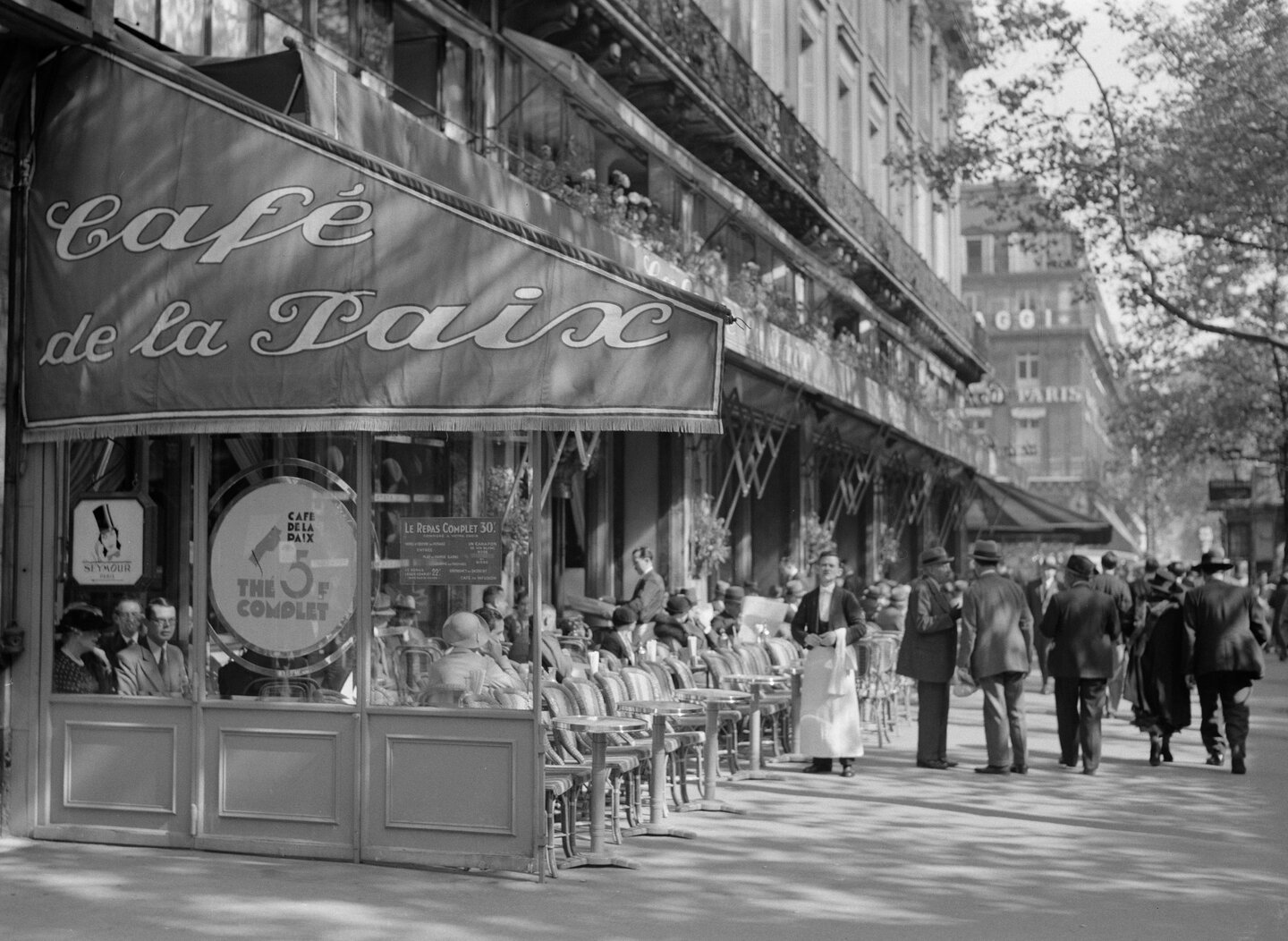
    <title type="html"><![CDATA[Le Café de la Paix: The Heart of Paris’ Theater District]]></title>
    <summary type="html"><![CDATA[<p><strong><em>The Café de la Paix, translated from French as the Cafe of Peace, is a historical Parisian institution that sits in the ninth arrondissement of Paris.  It was a favorite location of many notable people such as French writer Guy de Maupassant, and TV journalist Leon Zitrone.  The cafe is situated directly across the plaza from Opéra Garnier, the theater where author Gaston Leroux gained inspiration for his famous novel The Phantom of the Opera. </em></strong></p><img src="https://paris.cityandciv.com/files/fullsize/2ce4ed40f987561cebdf0fadf88aa38a.jpg" alt="Le Café de la Paix" /><br/><p>The Café was inaugurated on May 5, 1862 by Empress Eugenie, wife of Napoleon III,  and it officially opened July 30, 1862.  Its name came from Le Grand Hôtel de la Paix (now known as L’intercontinental Paris Le Grand), which got its name from the nearby street Rue de la Paix.  Its close proximity to Opéra Garnier added to its status as the heart of the theater district with a rich history concerning many well-known historical figures.  Some of these historical figures include Emile Zola, French novelist, playwright, and journalist and the Prince of Wales and future King of the United Kingdom, Edward VII. Author Oscar Wilde was also known to be a regular at the Café, and during the 1950’s it became host to German-American actress Marlene Dietrich who often stayed at the Grand Hôtel de la Paix.  This brought such massive crowds that the servers had to map out routes within the cafe to the kitchen, counters, and dining hall.  </p><p>Upon the declaration of war in 1939, the Café closed for the first time.  This closure did not diminish the spirits of those who worked at the cafe, though, when in 1944 a German grenade caused a fire within the cafe that was quickly put out by the head-waiter’s use of the soda siphons.  After the war, in 1948, a radio studio was installed which broadcasted the program “This is Paris” to the United States.  With hosts such as Maurice Chevalier, a French actor and entertainer, the broadcast was trying to reach an overseas audience to bring more tourists to France.  The broadcast featured special guests such as Yves Montand, an Italian-French singer and actor, and included songs and different types of sketches. </p><p>On August 22, 1975, the Café was declared a historic site by the French government and in 2003 it underwent a complete renovation, opening up the space and exhuming the original opulence from when it originally opened.  The Café is still very active and held close to Parisian hearts today.  For Easter they traditionally host a Grand Easter Brunch that includes a grand meal and a large Easter egg hunt for children.  The grand meal exemplifies the opulence of the Café de la Paix, with a price of 125€ per person.  </p><p><em><strong><a href="https://paris.cityandciv.com/items/show/9">For more (including 6 images) view the original article</a></strong></em></p>]]></summary>
    <published>2019-05-01T20:15:56+00:00</published>
    <updated>2026-03-04T21:28:17+00:00</updated>
    <link rel="alternate" type="text/html" href="https://paris.cityandciv.com/items/show/9"/>
    <id>https://paris.cityandciv.com/items/show/9</id>
    <author>
      <name>Mariah Workman</name>
    </author>
  </entry>
</feed>