<?xml version="1.0" encoding="UTF-8"?>
<feed xmlns="http://www.w3.org/2005/Atom">
  <title type="text">Paris City &amp;amp; Civ</title>
  <updated>2026-05-11T18:15:12+00:00</updated>
  <generator uri="http://framework.zend.com" version="1.12.20">Zend_Feed_Writer</generator>
  <link rel="alternate" type="text/html" href="https://paris.cityandciv.com/"/>
  <link rel="self" type="application/atom+xml" href="https://paris.cityandciv.com/items/browse?output=rss2"/>
  <id>https://paris.cityandciv.com/</id>
  <author>
    <name>Paris City &amp;amp; Civ</name>
    <uri>https://paris.cityandciv.com</uri>
  </author>
  <link rel="hub" href="https://pubsubhubbub.appspot.com/"/>
  <entry>
    <title type="html"><![CDATA[Square Montholon: A sanctuary for birds and for me]]></title>
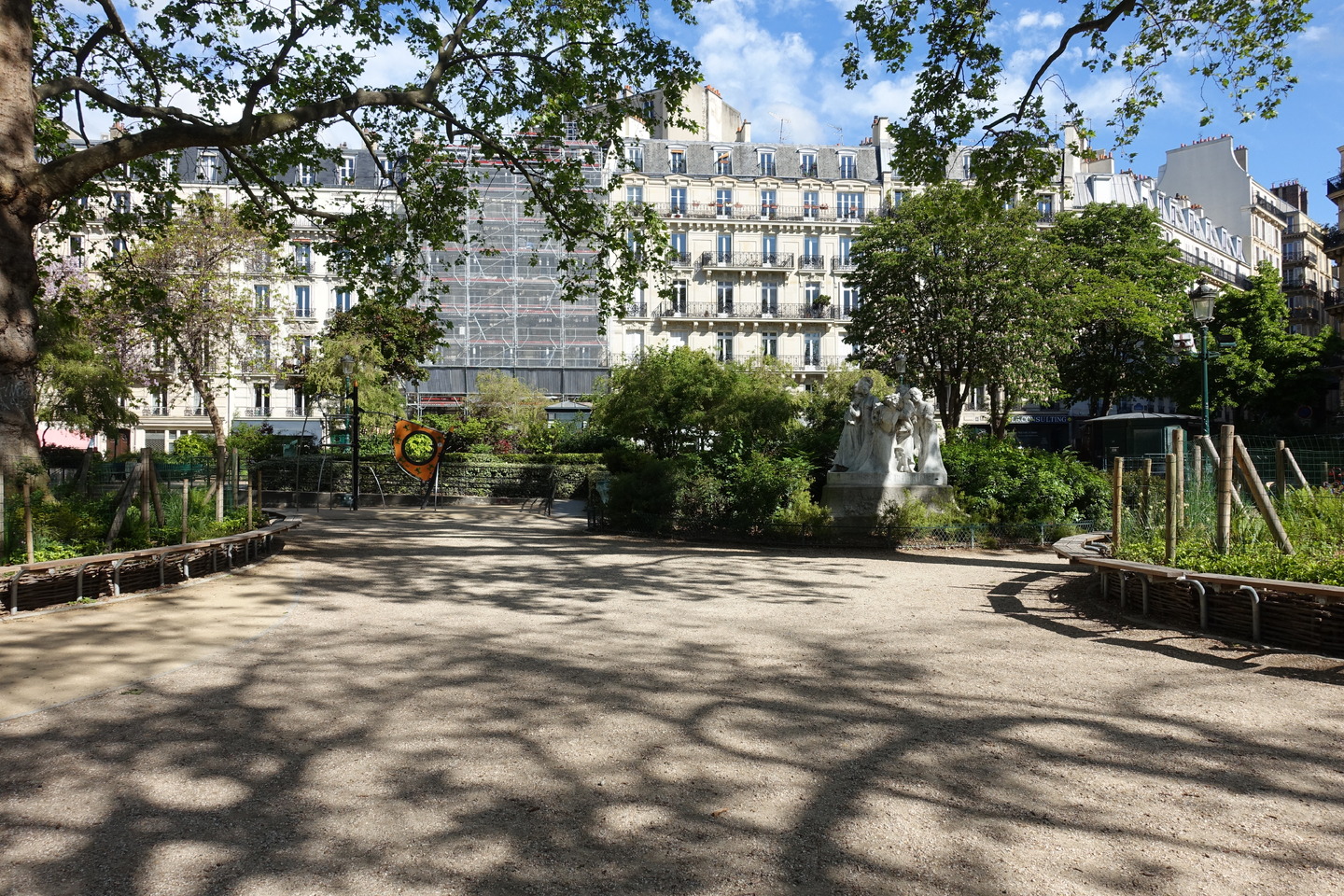
    <summary type="html"><![CDATA[<p><strong><em>Once the garden of an executioner, this square is now a beautiful green space. An ideal spot for gathering, the park houses four young girls, carved from stone yet filled with life.</em></strong></p><img src="https://paris.cityandciv.com/files/fullsize/fedbadd7bbafdc2481efe874a228a043.jpg" alt="Square Montholon @ Paris" /><br/><p>Square Montholon is the largest green space in the 9th arrondissement, measuring 4571 square meters. The space was originally the garden of the estate of Charles-Henri Sanson, an executioner of France, who came from a famous family of executioners operating in Paris from 1688 to 1847. It was transformed into Square Montholon in 1863 and now hosts different bird species and native plants, and emphasizes the importance of wildlife protection. There are two oriental plane trees that are each over a century old and are now over 30 meters tall. The area itself is bordered with entrances near each corner, and Louis-Philippe-style fencing, a Victorian-style of picket fencing used frequently in Parisian gardens.</p><p>While I had done research on Square Montholon before arriving in Paris, it was nothing like I expected it to be. The square was small and intimate but had so much packed into every nook and cranny. As I turned and took in my surroundings, I saw something I didn’t read about or see in the research I did. Towards the center of Square Montholon is a statue, Les Catherinettes by Julien Lovieux, created in 1908, depicting four young women celebrating Saint Catherine’s Day. The holiday, occurring on November 25th, is a day for unmarried women of the age of 25 and above (otherwise known as ‘Catherinettes’) to pray to Saint Catherine to find a husband. While the holiday started in the 10th century, French milliners popularized it in the early 1900s as a way to display extravagant hats, customarily using green and yellow to symbolize wisdom, faith, and success. The tradition has developed and changed over time, but is still celebrated today with over the top, work of art, hats. </p><p>As I looked at the young women before me, I couldn’t help but think about all of the working girls who may have walked through the spot I was standing in. The women in the statue looked so joyful, linking arms and practically falling over each other while walking. Coming to Paris with my own group of girls, I couldn’t help but feel like I knew the ones made of stone. I love that in a city with so much history and so many lives lived, I can find common ground with people who walked the grounds 100 years before me. It felt ironic that what was previously the garden of an executioner had become a beautiful community space—an incredibly bright future for a place with such an interesting and complicated past.</p><p>The square is a peaceful escape from the rest of the city, and even with its small size it is not cramped, or infected with the noise right outside its gates. The sounds from the streets surrounding the park were drowned out by rustling trees and birds chirping, in order to create the quiet space I sat within. The number of colorful birds that I saw above, flying from branch to branch, felt disproportionate to the amount of land available to them. Despite the fact that there was nothing keeping them there, they all seemed settled within the square. I found so much peace within the square, and couldn’t help but be taken by the community I felt sitting in such a beautiful public space. I wondered how many girls sat in that square thinking the same, and listening to the birds.</p><p><em><strong><a href="https://paris.cityandciv.com/items/show/111">For more (including 5 images) view the original article</a></strong></em></p>]]></summary>
    <published>2026-05-09T16:41:26+00:00</published>
    <updated>2026-05-11T18:15:12+00:00</updated>
    <link rel="alternate" type="text/html" href="https://paris.cityandciv.com/items/show/111"/>
    <id>https://paris.cityandciv.com/items/show/111</id>
    <author>
      <name>Elliot Glorioso Rendall</name>
    </author>
  </entry>
  <entry>
    <title type="html"><![CDATA[Place Denfert-Rochereau : Place d’Enfer is a historical square that highlights monuments such as the Lion de Belfort, Farmers General Wall Toll houses, and the entrance to the Catacombs of Paris.]]></title>
    <summary type="html"><![CDATA[<p><strong><em>Place Denfert-Rochereau is one of the largest public squares on the left bank. It is located in the 14th arrondissement of Paris and was formally known as Place d’Enfer. The old name comes from the Rue d’Enfer, translated as Gate of Hell, which was changed to Rue Denfert-Rochereau.. Scholars speculate that the name refers to the general uneasiness associated with the area whose lowlife inhabitants included thieves and other unsavory characters.  Others believe the name is associated with the iron door (en fer- iron) part of the Philip Augustus Wall.</em></strong></p><img src="https://paris.cityandciv.com/files/fullsize/783977f460fb99dd1172625e40bdaad1.jpg" alt="Place Denfert-Rochereau avec la réplique du Lion de Belfort en son centre - Paris XIV" /><br/><p>Named after the French commander Pierre Denfert-Rocheeau who organized the defense during the France-Prussian War at the Siege of Belfort, the Place dates back to the 18th century through a series of letters that refers to the site as being part of the old Farmers General Wall. The Wall of the Farmers General wall was authorized in 1782 by Charles Alexander de Calonne, the Finance Minister, and financed by the Farmers General, a syndicate of tax "farmers" or collectors who contracted with the government for the authority to collect taxes on behalf of the king. The wall had 47 gates and 16 toll houses that were built in order to oversee the collection of funds. Only four of the toll houses still stand today; these include, Rotonde de Monceau, Rotonde de la Villette, the Barriere du Trone, and the Barriere d’Enfer. These Toll Houses were stationed as a point of entry in and out of the city to collect import duties on goods entering into Paris.  Opposition to these unpopular taxes in the 18th century helped fuel the French Revolution.  The gate takes the name of Barriere d’Enfer and is comprised of two toll houses on the Avenue du Colonel-Henri-Roi-Tanguy designed by architect Claude Nicolas Ledoux and built in 1787. One of the two toll houses is currently the entrance to the catacombs. The other former toll house houses the Direction de la Voirie et des Deplacements (Directorate of Roads and Transport). </p><p>In the center of the Place Denfert-Rochereau stands a large bronze statue, the Lion de Belfort, by Frédéric Auguste Bartholdi who is best known as the sculptor of the Statue of Liberty. In 1880, the statue was placed in the middle of a traffic circle. to commemorate the resistance against the Prussians during the Siege of Belfort led by Colonel Denfert-Rochereau. The Lion de Belfort symbolizes courage and opposition during the Franco-Prussian War (1870-1871). </p><p>Place Denfert-Rochereau is located at the intersections of Boulevard Raspail, Boulevard Argo, and Boulevard Saint-Jacques. Currently, Place Denfert-Rochreau serves as a Paris metro stop and train station.  Metro lines 4 and 6 lines are accessible here as well as the RER B line. </p><p><em><strong><a href="https://paris.cityandciv.com/items/show/34">For more (including 6 images) view the original article</a></strong></em></p>]]></summary>
    <published>2019-05-13T03:29:12+00:00</published>
    <updated>2026-03-04T21:28:18+00:00</updated>
    <link rel="alternate" type="text/html" href="https://paris.cityandciv.com/items/show/34"/>
    <id>https://paris.cityandciv.com/items/show/34</id>
    <author>
      <name>Gabriella L. Guy</name>
    </author>
  </entry>
</feed>
