<?xml version="1.0" encoding="UTF-8"?>
<feed xmlns="http://www.w3.org/2005/Atom">
  <title type="text">Paris City &amp;amp; Civ</title>
  <updated>2026-05-11T18:15:12+00:00</updated>
  <generator uri="http://framework.zend.com" version="1.12.20">Zend_Feed_Writer</generator>
  <link rel="alternate" type="text/html" href="https://paris.cityandciv.com/"/>
  <link rel="self" type="application/atom+xml" href="https://paris.cityandciv.com/items/browse?output=rss2"/>
  <id>https://paris.cityandciv.com/</id>
  <author>
    <name>Paris City &amp;amp; Civ</name>
    <uri>https://paris.cityandciv.com</uri>
  </author>
  <link rel="hub" href="https://pubsubhubbub.appspot.com/"/>
  <entry>
    <title type="html"><![CDATA[Square Montholon: A sanctuary for birds and for me]]></title>
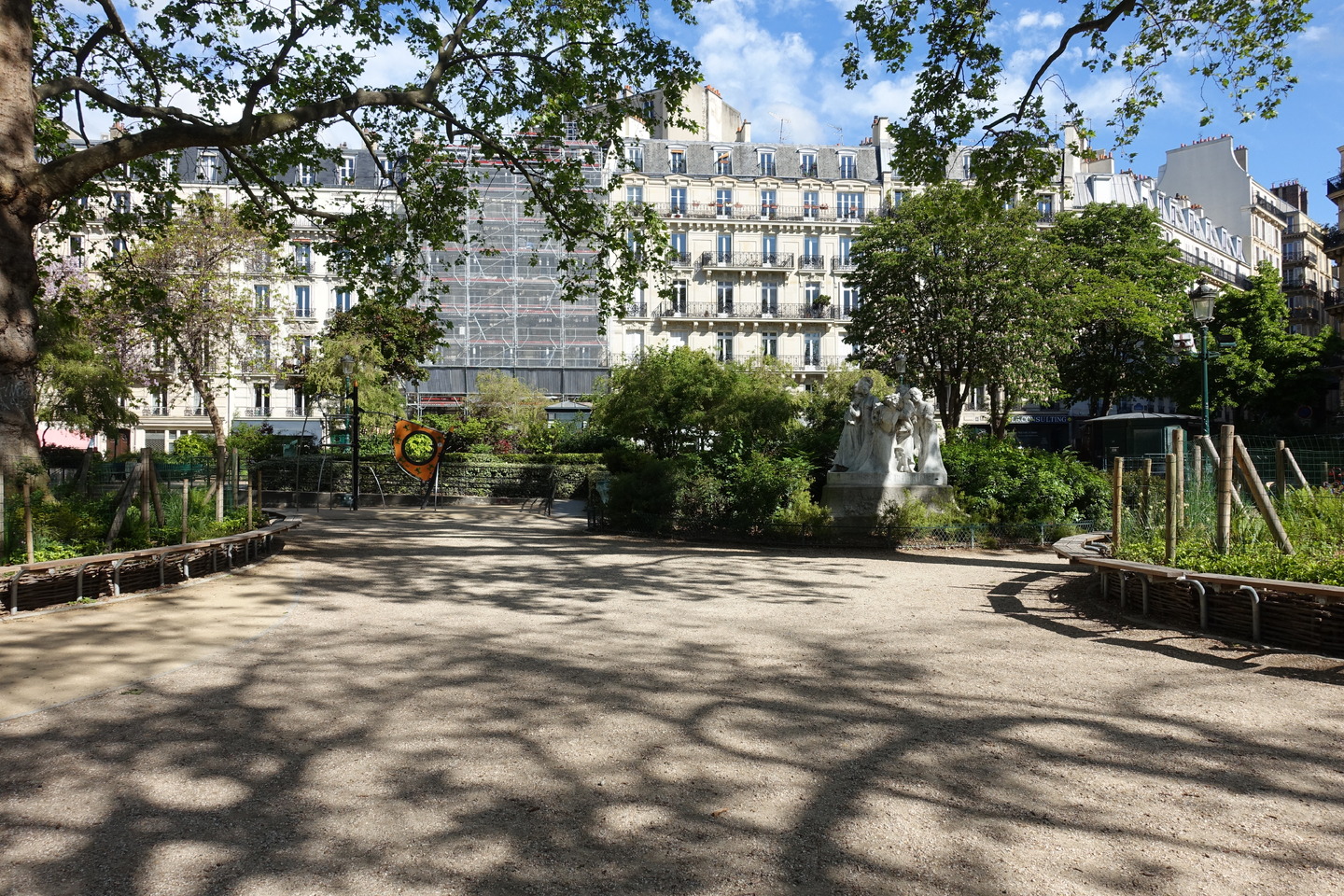
    <summary type="html"><![CDATA[<p><strong><em>Once the garden of an executioner, this square is now a beautiful green space. An ideal spot for gathering, the park houses four young girls, carved from stone yet filled with life.</em></strong></p><img src="https://paris.cityandciv.com/files/fullsize/fedbadd7bbafdc2481efe874a228a043.jpg" alt="Square Montholon @ Paris" /><br/><p>Square Montholon is the largest green space in the 9th arrondissement, measuring 4571 square meters. The space was originally the garden of the estate of Charles-Henri Sanson, an executioner of France, who came from a famous family of executioners operating in Paris from 1688 to 1847. It was transformed into Square Montholon in 1863 and now hosts different bird species and native plants, and emphasizes the importance of wildlife protection. There are two oriental plane trees that are each over a century old and are now over 30 meters tall. The area itself is bordered with entrances near each corner, and Louis-Philippe-style fencing, a Victorian-style of picket fencing used frequently in Parisian gardens.</p><p>While I had done research on Square Montholon before arriving in Paris, it was nothing like I expected it to be. The square was small and intimate but had so much packed into every nook and cranny. As I turned and took in my surroundings, I saw something I didn’t read about or see in the research I did. Towards the center of Square Montholon is a statue, Les Catherinettes by Julien Lovieux, created in 1908, depicting four young women celebrating Saint Catherine’s Day. The holiday, occurring on November 25th, is a day for unmarried women of the age of 25 and above (otherwise known as ‘Catherinettes’) to pray to Saint Catherine to find a husband. While the holiday started in the 10th century, French milliners popularized it in the early 1900s as a way to display extravagant hats, customarily using green and yellow to symbolize wisdom, faith, and success. The tradition has developed and changed over time, but is still celebrated today with over the top, work of art, hats. </p><p>As I looked at the young women before me, I couldn’t help but think about all of the working girls who may have walked through the spot I was standing in. The women in the statue looked so joyful, linking arms and practically falling over each other while walking. Coming to Paris with my own group of girls, I couldn’t help but feel like I knew the ones made of stone. I love that in a city with so much history and so many lives lived, I can find common ground with people who walked the grounds 100 years before me. It felt ironic that what was previously the garden of an executioner had become a beautiful community space—an incredibly bright future for a place with such an interesting and complicated past.</p><p>The square is a peaceful escape from the rest of the city, and even with its small size it is not cramped, or infected with the noise right outside its gates. The sounds from the streets surrounding the park were drowned out by rustling trees and birds chirping, in order to create the quiet space I sat within. The number of colorful birds that I saw above, flying from branch to branch, felt disproportionate to the amount of land available to them. Despite the fact that there was nothing keeping them there, they all seemed settled within the square. I found so much peace within the square, and couldn’t help but be taken by the community I felt sitting in such a beautiful public space. I wondered how many girls sat in that square thinking the same, and listening to the birds.</p><p><em><strong><a href="https://paris.cityandciv.com/items/show/111">For more (including 5 images) view the original article</a></strong></em></p>]]></summary>
    <published>2026-05-09T16:41:26+00:00</published>
    <updated>2026-05-11T18:15:12+00:00</updated>
    <link rel="alternate" type="text/html" href="https://paris.cityandciv.com/items/show/111"/>
    <id>https://paris.cityandciv.com/items/show/111</id>
    <author>
      <name>Elliot Glorioso Rendall</name>
    </author>
  </entry>
  <entry>
    <title type="html"><![CDATA[Bois de Vincennes: An Escape from City Life]]></title>
    <summary type="html"><![CDATA[<p><strong><em>Bois de Vincennes, the “Eastern Lung of Paris,” is not only one of the largest, most breathtaking natural wooded areas, it also comes from a rich history and is a place of peace, learning, socializing, and exploring.</em></strong></p><img src="https://paris.cityandciv.com/files/fullsize/77489356e4d37da84445198649369ee3.jpg" alt="The Parc Floral de Paris" /><br/><p>Located just within the Eastern outskirts of the city of Paris, lies one of the city’s most beautiful and interactive green areas. Spanning almost 40 square miles, Bois de Vincennes is the largest park within Paris surpassing the more well-known, but significantly smaller, Bois de Boulogne (only about 3.4 square miles). It can be accessed through the Porte Dorée along the outer border of the 12th arrondissement. This wondrous place is not your typical park. The urban park includes many entertainment options and attractions for the public making it suitable for anyone's needs or mood. These attractions include a cycling and horse-racing stadium, a botanical garden, arboretum and even a zoo. It offers leisure as well as sports activities, and beautiful nature scenes that house hundreds of various species that you won’t be able to find within the city.</p><p>The history of this park spans as far back as the 12th century. A large part of Bois de Vincennes is the Château de Vincennes, which was built in 1340. Charles V was the first to settle and make the building proper royal housing.  At the time, Bois De Vincennes was just known as a wooded area surrounding the royal property. It wasn’t technically turned into a public park until after the revolution, under Napoleon III. In more recent times, the park was also a major location for the 1900 Summer Olympics. Most events took place within Cipale Vélodrome, a large cycling stadium that the park offers. This velodrome was also the finish line for the Tour de France between 1968 to 1974. Today, the park is open all day, everyday, to anyone willing to come and enjoy the peacefulness. </p><p>A primary area of the park is the Parc Zoologique de Paris, known as France’s largest and most astonishing zoo. This zoo is none like your average either. It is sectioned into five different biomes offering an unimaginable amount of diverse species of not only animals, but plants and insects. Parisians, or any tourists, can get a taste of numerous contrasting species from around the world in select climates, all in one area near them. This immersive zoo includes spaces of free roaming which allow visitors to even get up close to certain animals and insects such as giraffes, jaguars, reptiles, rhinos, an extraordinary number of types of birds, and more. Bois De Vincennes contains spaces, atmospheres and or attractions that can be difficult to find anywhere else. The park also has four lakes. Lake Daumesnil being the largest of them then, Lac de Gravelle, Lac des Minimes, and Lake Saint-Mandé. All lakes connect together with a span of rivers, carving out beautiful scenic walkways throughout the forest as well. This park offers many physical activities such as running, walking, and biking trails which carry all throughout the park.</p><p>Bois de Vincennes is another world within Paris. This park is an escape from the city offering fresh air, shaded spaces, and never-ending paths through the majestic greenery of nature.</p><p><em><strong><a href="https://paris.cityandciv.com/items/show/60">For more (including 2 images) view the original article</a></strong></em></p>]]></summary>
    <published>2022-04-26T02:24:59+00:00</published>
    <updated>2026-03-04T21:28:19+00:00</updated>
    <link rel="alternate" type="text/html" href="https://paris.cityandciv.com/items/show/60"/>
    <id>https://paris.cityandciv.com/items/show/60</id>
    <author>
      <name>Kendall Adams</name>
    </author>
  </entry>
  <entry>
    <title type="html"><![CDATA[Parc du Champ-de-Mars: A Site of Violence, Parades, and Iconic Touristic Views]]></title>
    <summary type="html"><![CDATA[<p><strong><em>Arguably one of the most well known and iconic symbols of both Paris and France is Parc du Champ-de-Mars. It is a rectangular shaped public green space stretching from the Eiffel Tower to the Ecole Militaire. It is a place, an image, known to most around the world. It lies in the shadow and is like a red carpet rolled out for the Eiffel Tower.</em></strong></p><img src="https://paris.cityandciv.com/files/fullsize/222a7895f1849a85bb230dab6c42b8c0.jpg" alt="2018 Euro Cup Viewing party at Parc du Champ-de-Mars." /><br/><p>Parc du Champ de Mars lies in the neighborhood of Les Invalides, in the 7th arrondisement a neighborhood once ruled by the people society had forgotten in the 17th and 18th centuries due to hospital located within the neighborhood to care for the severely injured soldiers. That hospital remains operational today. Also, in the neighborhood is the Ecole Militaire. It is a military school that opened in 1760 and was purposefully designed to train young men from the lower end of the socioeconomic end of the spectrum. The grounds of Parc du Champ de Mars were once used as training grounds as well.  The schools remains in operation today as a military training academy. In its current state, the neighborhood is one of the most desirable areas to live in Paris and a draw for tourists from around the globe. The green space of the park is filled with reflecting pools, pedestrian walkways, all varieties of perennials and annuals as well as symmetrically and extraordinarily pruned hybrid sycamore trees.</p><p>The park opened in 1780 and was named in tribute to the  Roman God of War: Mars. At about 103 acres in size ,the land the park currently encompasses was originally known as Grenelle and served as a market garden, or community garden where plots of land could be claimed by an individual for growing purposes. In 1791, during the French Revolution, the French National Assembly issued a decree declaring that King Louis XVI would remain monarch. Those opposing the decree gathered at the park and upon not dispersing after warning shots, the French National Guard opened fire on the crowd. This event is known as the Champ de Mars Massacre. It was loyalist Marquis de Lafayette who lead the charge against the rebels. The name may sound familiar to Americans because it is the same General Lafayette who commanded American troops in several battles during the American Revolution. Descendants of his family still own property on the park, Hermitage Apartment Rental.</p><p>Modern improvements add more flavor to the historic nature of the park. Barriers have been added in various locations to thwart terrorist attacks by automobile. In the year 2000, the Wall of Peace was constructed as a symbol of welcome. It is located at the far southeastern flank of the park and remains today, although it was initially meant to be temporary. Modern uses of the park include typical passive uses and the site is also used for large public events such as concerts, fireworks displays, and to show sports events on  giant screens such as the 2018 Euro World Cup game. </p><p><em><strong><a href="https://paris.cityandciv.com/items/show/46">For more (including 3 images) view the original article</a></strong></em></p>]]></summary>
    <published>2019-05-13T07:43:25+00:00</published>
    <updated>2026-03-04T21:28:19+00:00</updated>
    <link rel="alternate" type="text/html" href="https://paris.cityandciv.com/items/show/46"/>
    <id>https://paris.cityandciv.com/items/show/46</id>
    <author>
      <name>Michael Rogalski</name>
    </author>
  </entry>
  <entry>
    <title type="html"><![CDATA[Parc André Citroën: Modern Garden of Versailles or Design Misstep?]]></title>
    <summary type="html"><![CDATA[<p><strong><em><i>Parc André Citroën, sitting between City Centre and the residential zone of Paris, was built to act as an intermediary to the rural and urban lifestyles that reside on either side. At first, the park drew crowds who were looking for an escape from the congested city. It’s modern take on the historical gardens like Versailles sparked interest in those looking for a place to get away. This didn’t last long as controversy against the park grew when people started to question whether the park’s design lacked practical commodities that could have made the garden an escape from busy, city life.</i></em></strong></p><img src="https://paris.cityandciv.com/files/fullsize/ab2d44d6254ed2aeb932d0de58959360.jpg" alt="Park Seen from Balloon" /><br/><p>Parc André Citroën was built in 1992 in the 15th Arrondissement on the South bank of the Seine river. The park was built on a former Citroen automobile factory, and named after the company’s founder, Andre Citroën. The park was designed with the intention of intertwining nature with the architectural side of central Paris. The entrance of the park reflects an urban environment designed with orderly, geometric lines. The Great Lawn in the middle has diagonal pathways cutting through geometric blocks of foliage which surround the large open space. In 1999, the park started offering hot air balloon rides in this space where people could pay to overlook the city. At the end of the lawn are two giant, modern greenhouses. These greenhouses contain six themed gardens that related to each of the six senses: sight, smell, touch, taste, hearing, and intuition. </p><p>This mediator between urban and rural life dwindled in fame when people started to question whether the park was designed without focusing on practicality and looking more towards the minimalism, and uniformity that often goes hand-in-hand with modern architecture. First, criticism arose when attendees complained about lack of seating and resting points within the park. The Great Lawn is a place where a variety of people can run and play. Yet, for parents who want to sit and watch their children or for those resting to people watch seating is limited. The park has even been described as anti-social. Although not enforced strictly, running through the fountains impeded in the ground is frowned upon. The general lack of activity is off-putting to park-goers. Even the famous hot air balloon rides have come to an end. Present-day attendees have reported that the balloon has remained in the park unused for years. The themed gardens have also faced criticism. Although the modern, almost spiritual environments were designed so keenly, the gardens have been described as detached, impersonal zones. According to a recent critic of Parc Andre Citroen, Victor Grennan (2016): Sometimes you feel at one with nature in these small private gardens, but on the other hand you feel like a visitor at a zoo viewing plants trapped between geometric conformity.</p><p>The designers of Parc André Citroën had great intentions for how well the park would fit into the bustling city aesthetically, yet they lacked practicality and ecological thought to pull it off. The natural side of the park is entirely made up of man-made environments. Instead of focusing on the management of nature, creators were more interested in the overall design of the environment. I can’t be the first one to say that this park needs a reboot. Not even two miles away from the Eiffel Tower, Parc André Citroën could be a beautiful spot for those visiting the city to relax and take in a modernized version of the large, historical gardens Paris is known for. It could even become what it was intended for, an escape for residents of the city looking to get away from tight, crowded Parisian streets. </p><p><em><strong><a href="https://paris.cityandciv.com/items/show/33">For more (including 3 images) view the original article</a></strong></em></p>]]></summary>
    <published>2019-05-13T03:06:09+00:00</published>
    <updated>2026-03-04T21:28:18+00:00</updated>
    <link rel="alternate" type="text/html" href="https://paris.cityandciv.com/items/show/33"/>
    <id>https://paris.cityandciv.com/items/show/33</id>
    <author>
      <name>Anne Crotty</name>
    </author>
  </entry>
</feed>
