<?xml version="1.0" encoding="UTF-8"?>
<feed xmlns="http://www.w3.org/2005/Atom">
  <title type="text">Paris City &amp;amp; Civ</title>
  <updated>2026-03-04T21:28:19+00:00</updated>
  <generator uri="http://framework.zend.com" version="1.12.20">Zend_Feed_Writer</generator>
  <link rel="alternate" type="text/html" href="https://paris.cityandciv.com/"/>
  <link rel="self" type="application/atom+xml" href="https://paris.cityandciv.com/items/browse?output=rss2"/>
  <id>https://paris.cityandciv.com/</id>
  <author>
    <name>Paris City &amp;amp; Civ</name>
    <uri>https://paris.cityandciv.com</uri>
  </author>
  <link rel="hub" href="https://pubsubhubbub.appspot.com/"/>
  <entry>
    <title type="html"><![CDATA[The Western Tympanums of Notre Dame: Welcome to Heaven]]></title>
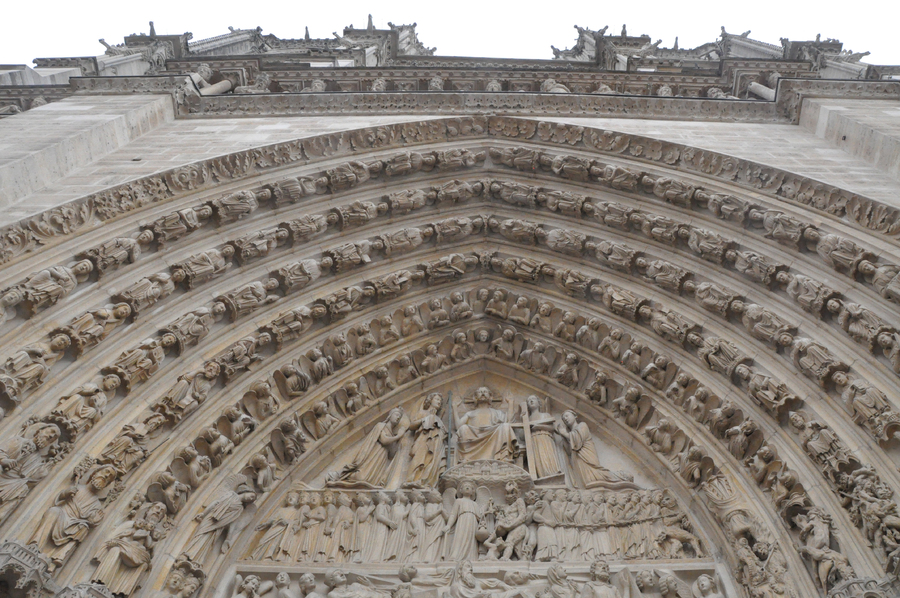
    <summary type="html"><![CDATA[<p><strong><em>During many of my Zoom induced daydreams, I find my mind wandering off to 2015 and the first time I visited Paris. The city was my last stop in a 6 week solo backpacking trip. The drain of travel and sharing room after room with no less than a dozen people at a time (three quarters of whom always snored) had me feeling like Quasimodo on the day I visited Notre Dame. As I neared the cathedral, I felt a number of eyes on me. However, it wasn’t the hundreds of tourists flowing past me, but the eyes of every single statute that surrounds each of the three portals on Notre Dame’s western facade. The eyes of angels, kings, and assorted biblical figures and saints all seemed fixed on me, giving me a brief flashback to that scene in The Haunting when wooden cherubs turn their head and stare at Lili Taylor. After reliving a slightly traumatic childhood moment courtesy of Ms. Taylor, I was left wondering what it must have been like for the millions that have walked through these same doors since the 13th century.</em></strong></p><img src="https://paris.cityandciv.com/files/fullsize/c1feffa54d01f21600d25a46cef25fe2.jpg" alt="Tympanum of central portal of Notre-Dame de Paris" /><br/><p>The Notre Dame cathedral is what some would call a “poor man's bible.” That is, a church which relies on artwork it to teach biblical parables to the uneducated and illiterate. For example, the two friezes (horizontal rows of sculptures) and the sculptures within the tympanum (the triangular space that forms the center of a pediment) above the central portal on the Western Facade features scenes of the Last Judgement. In the scene, the archangel Michael weighs the souls of those that have been resurrected. While the sinners are led off to hell by a demon, the “good” Christians are led off to heaven. Essentially, it was made to be overwhelming and a little scary to make sure you learned what would happen to you if you sinned (hint: it’s hell). Together, all the scenes depicted in each of the three portals combine to create an allegory for entering heaven. </p><p>Finished sometime in the 1220’s, and the last of the three portals to be constructed, the Portal of the Last Judgement has a stunning amount of detail to it. The face of each soul is just different enough to separate them individually. However, the souls of the damned are full of genuine fear and horror. You really get the sense that they are not looking forward to hell. Below them, a frieze of the new resurrected souls stare up at them, awaiting their own fate. Above them all, within the tympanum, Jesus sits on a throne showing the wounds in his hands, and feet. To his right and left stand angels and Mary and John praying. Although he sits, Christ is larger than everyone, serving as a reminder of his suffering for the sake of mankind. Encompassing all of this are five arches full of a heavenly choir made up of various angels, saints, kings and various other religious people watching the scene unfold. Hell is present here. At the bottom right of each arch are multiple souls being tortured by demons. The placement of these little vignettes appears to be purposeful. Beyond them technically being below heaven, these lie on Christ’s left side. This is also the direction to which the dammed are led. While it’s hard to get a definitive answer on it, in Christian symbolism, the left hand appears to be considered the “bad side” of god. The devil’s side. And this the part where I apologize to any left-handed Catholics who may now be experiencing flashbacks of nuns smacking them with rulers for using their left hand. Between the two individual doors is a large statue of a Christ teaching, bringing back the idea that these were used to teach lessons rather than act simply as decoration. </p><p>The two slightly smaller portals that flank the central portal on the western facade are slightly less… preachy (pardon the pun). To the right of the central portal lies the North Portal. (not to be confused with the North Transept Portal on the north side of the building). This portal is also known as the Coronation Portal or the Portal of the Virgin. It’s also a slightly less menacing door when you compare it to the previous one. Separating the two doors here is a large statue of the Virgin with the child Christ. Within the tympanum, instead of the devils and judged souls are two different scenes. One features three prophets on the left and three Old Testament kings on the right. Above them lies Mary on her deathbed, surrounded by Jesus and the 12 apostles. The surrounding arches are again filled with a heavenly choir of anonymous angels and saints watching the scenes unfold. </p><p>To the right of the central is the South Portal of the West Façade (also not to be confused with the South Transept Portal). Known as the Saint Anne Portal, this particular portal is the oldest of the three main portals. The statues within its tympanum were actually part of the church of Saint Mary, which was dismantled with the expansion of Notre Dame’s choir. If you look closely, you’ll notice the inclusion of something we haven’t seen in the other two portals: foliage. During construction of the cathedral, it was realized that the tympanum was actually too small to fill the space, so two strips of foliage were added as well as the two angels seen at the top. Who hasn’t realized too late that something was too small to fill a gap and filled it with leaves and grace? With all of its individual figures and ornate flourishes, the Saint Anne Portal is as if not more detailed as the Central Portal. The main focus is, surprisingly, not Saint Anne but rather the Virgin Mary with the infant Christ on her knee. She is flanked by an angel and the bishop of Paris to one side and a French king and another angel to the other side. The frieze directly below tells the stories of the Annunciations, the Nativity, and the Epiphany while the lowest frieze depicts the marriage of Joachim and Anne (Mary’s parents) as well as the marriage of Mary and Joseph. </p><p>Using the word portal rather than simply “entry” or “door” can seem a little pretentious. The word usually conjures the mental image of a massive, beautiful, but also slightly terrifying swirling ball of lights that serves as an entryway to another world. The portals of Notre Dame aren’t that different from this sci-fi idea. They are overwhelmingly beautiful and a little scary. But they also serve as an entrance to another world. They’re the entrance to heaven on Earth.</p><p><em><strong><a href="https://paris.cityandciv.com/items/show/71">For more (including 3 images) view the original article</a></strong></em></p>]]></summary>
    <published>2024-04-29T21:54:33+00:00</published>
    <updated>2026-03-04T21:28:19+00:00</updated>
    <link rel="alternate" type="text/html" href="https://paris.cityandciv.com/items/show/71"/>
    <id>https://paris.cityandciv.com/items/show/71</id>
    <author>
      <name>Cory Williams </name>
    </author>
  </entry>
  <entry>
    <title type="html"><![CDATA[The Church of Notre-Dame-de-l&#039;Assomption: A Refuge in the City of Light]]></title>
    <summary type="html"><![CDATA[<p><strong><em>Along the narrow but bustling Rue Saint-Honoré in Paris's 1st arrondissement, the church of Notre-Dame-de-l'Assomption has stood tall for centuries and witnessed hundreds of years of war, piece and change in the city.   During its use as a convent, as a church for Polish émigrés in the mid-19th century and its current use as a Catholic church, Notre-Dame-de-l'Assomption has served as a refuge in the City of Light!&nbsp;</em></strong></p><img src="https://paris.cityandciv.com/files/fullsize/87f568a431678ed151d1d9dabba857d3.jpg" alt="Nativity Scene" /><br/><p>An all-female religious order in the late 17th century, the Ladies of the Assumption (Dames de l’Assomption), were the first occupants of the building, which was constructed between 1670-76. It continued to be used by wealthy women as a sort of religious refuge through the Ancien Régime. However, this changed when the French Revolution, which opposed both royalty and the Catholic Church, tore through Paris in 1789.</p><p>As the revolution raged on and change ran rampant across Paris, the church building became military barracks in 1793. After the French Revolution ended and France returned to royalty, Notre-Dame-de-l’Assomption’s original religious use was restored. The Church of Notre-Dame-de-l’Assomption played an important part in an often-overlooked, but still quite important historical event- the Great Emigration of Polish exiles to Paris.</p><p>Political turmoil in Poland and Lithuania led to the emigration of over 50,000 Poles and Lithuanians that peaked in 1830 and 1831. Many of these émigrés- especially those of Polish Catholic origin- migrated to Paris, where the Polish Catholic Mission had been recently established. Notre-Dame-de-l’Assomption soon became an important centerpiece of Paris’s Polish Catholic community and, just as it did when it was a women’s convent, acted as a sort of refuge and an important community establishment. Throughout the world in ethnic communities, churches have long been the centerpiece, with Notre-Dame-de-l’Assomption being no exception!</p><p>After its reestablishment as a church and the “demographic shift” to Polish Catholic émigrés, Notre-Dame-de-l’Assomption retained its religious use and remained intact even as Paris grew and changed around it (i.e. industrialization and World Wars I and II). As tourism in Paris grew because of the city’s history and architecture, Notre-Dame-de-l’Assomption gained another use- as a tourist attraction for those interested in the church’s rich past and/or Roman Catholics who visited the church as a connection to their faith. Despite the city changing around its Polish Catholic community since its founding nearly two centuries ago, Mass is still said in Polish every week and it remains a home parish for many.</p><p>In conclusion, Notre-Dame-de-l’Assomption has changed quite a bit since its founding during the Ancien Régime, but, yet, it hasn’t. The church has weathered many storms and seen many changes- revolution, a demographic shift brought by the Great Emigration, industrialization, World Wars I and II, modernization- but, since its earliest days as a convent, it has served as a refuge in one way or another- a refuge in the City of Light.</p><p><em><strong><a href="https://paris.cityandciv.com/items/show/55">For more (including 3 images) view the original article</a></strong></em></p>]]></summary>
    <published>2022-04-25T05:11:20+00:00</published>
    <updated>2026-03-04T21:28:19+00:00</updated>
    <link rel="alternate" type="text/html" href="https://paris.cityandciv.com/items/show/55"/>
    <id>https://paris.cityandciv.com/items/show/55</id>
    <author>
      <name>Andrew D. France</name>
    </author>
  </entry>
  <entry>
    <title type="html"><![CDATA[Saint Etienne du Mont: Catholic Church and pilgrimage location to the tomb of Sainte-Genevieve in Paris&#039; Latin Quarter]]></title>
    <summary type="html"><![CDATA[<p><strong><em>Situated on Paris’ Left Bank in the 5th Arrondissement, the Church of Saint Etienne du Mont possesses both Gothic and Renaissance Art that can be traced back through its rich history. Of the things that are enclosed in Saint Etienne du Mont are relics of Sainte-Genevieve. Many of her relics were destroyed in a fire that occurred at the abbey of the Church of Sainte-Genevieve during the Revolution except for a few items which were then transferred to the nearby Saint Etienne du Mont Church.</em></strong></p><img src="https://paris.cityandciv.com/files/fullsize/59baa0810d41fc4ee934dd2dfbae5c6a.jpg" alt="Paris, Saint-Etienne-du-Mont--2014--1688" /><br/><p>Sainte-Genevieve was born in 422 and became religious at a very young age. Once she moved to Paris, she became known for being religious and helping others. Catholic saints are known for some type of miracle that they made happen, and Genevieve’s was a vision predicting that the Huns were going to invade. She used her religion to calm others living in the area and assured them that they were protected by heaven. The Huns invaded and were unsuccessful in their quest. The location of the Church of Sainte-Genevieve is important to understanding the construction of Saint Etienne du Mont. Clovis, the King at the time, said that he would build a church if he conquered the king of a Visigoths, Alaric II. Clovis narrowed down his sights on Paris where the Church of Sainte-Genevieve was ultimately built. Once the Sainte-Genevieve church became outdated, Saint Etienne du Mont was chosen to be constructed nearby so that the people could still have a church to use for practicing their religion, which is how the Sainte-Genevieve relics and tomb made their way into the Church of Saint Etienne du Mont. </p><p>The construction of the Saint Etienne du Mont Church was very expansive, taking 107 years to complete. This explains why the church started with a Gothic apse and ended with features from the Renaissance when the final altar was blessed in 1626. From the exterior of Saint Etienne du Mont, the façade, which was built between 1610 and 1622, is very evident. The façade resembles Renaissance style but also obtains Gothic style as the building reaches the top where the bell tower is. The original façade was destroyed during the Revolution and had to be re-constructed in the nineteenth century by Victor Baltard. Beside the church, Louis d’Orleans built a mansion for himself to live in sometime in the 18th century, referred to as the presbytery. </p><p>The interior of Saint Etienne du Mont is very detailed. The Sainte-Genevieve chapel, rood screen, pulpit, and organ are all aspects of the church that have significance to the audience and meanings connected to the past. Rood screens were popular in the Middle Ages to separate the crowd attending the mass from the priest and choir. As time went on, rood screens were left behind to allow for all people to be visible in the church, but Saint Etienne still has their rood screen, the only one left in Paris. The pulpit is now used as the place where the priest preaches, and is Baroque style with depictions of Saints Stephen, Augustine, and Jerome. The organ at Saint Etienne du Mont has been altered for centuries by numerous people, including Pierre le Pescheur. There are 7,000 total pipes on the organ, some of which are nearly twenty feet tall, but they are not all able to be seen from the audience. In 1956, the organ was made bigger by Maurice Durufle and other work on it has taken place in 1975 and the early 21st century. </p><p>Stained-glass windows are present throughout the church, depicting Saints Stephen and Etienne. These windows depict the death and ascension into heaven of Saint Etienne as well as Saint Stephen preaching and a wild beast watching over his dead body. The stained-glass windows in the ambulatory of the church are notable because they have been in place since this portion of the church was built. Many of the other stained-glass windows in the gallery were created and have been in Saint Etienne du Mont church since the early seventeenth century. </p><p>Saint Etienne du Mont is unlike many other churches because of its affiliation with more than one saint. This church is special because of its creation as a result of the abbey of Sainte-Genevieve succumbing to a fire during the Revolution. Because of Sainte-Genevieve’s vision in seeing that the Huns were going to invade, thus allowing her to urge others to pray for their safety, she is remembered today during her novena between January 3-11 where people from all over the world visit Saint Etienne du Mont Church to pray to her in the candlelit church.</p><p><em><strong><a href="https://paris.cityandciv.com/items/show/54">For more (including 5 images) view the original article</a></strong></em></p>]]></summary>
    <published>2022-04-25T04:41:37+00:00</published>
    <updated>2026-03-04T21:28:19+00:00</updated>
    <link rel="alternate" type="text/html" href="https://paris.cityandciv.com/items/show/54"/>
    <id>https://paris.cityandciv.com/items/show/54</id>
    <author>
      <name>Luke Ols</name>
    </author>
  </entry>
  <entry>
    <title type="html"><![CDATA[The Church of Saint-Séverin: A historical hodgepodge of the Latin Quarter]]></title>
    <summary type="html"><![CDATA[<p><strong><em>As the oldest church in the heart of the Left Bank, the Church of Saint-Séverin is a site of religious history, art, and architecture. The church has survived a Viking attack, is home to the oldest bell in Paris, and had skirted destruction in the wake of modernizing Paris. </em></strong></p><img src="https://paris.cityandciv.com/files/fullsize/dc348b4b12f3e74615fb5c354330deb9.jpg" alt="Church of Saint-Severin" /><br/><p>The church began as a humble oratory in the sixth century then morphed into a chapel and later a basilica. Nothing remains of the eleventh century structure after it was attacked by Vikings and was rebuilt in the thirteenth century. Three quarters of that building was burned down at the end of the Hundred Years War and it was rebuilt yet again in the fifteenth century. At the time, the fifteenth century construction boasted the tallest bell tower in Paris. In the sixteenth century, surrounding buildings were torn down and the church was expanded to accommodate its growing number of parishioners. In the seventeenth century, Louis XIV’s cousin, the Duchess of Montpensier, funded the southern chapel addition. </p><p>The current flamboyant Gothic facade dates back to its fifteenth century reconstruction. The gargoyles are indicative of the traditional Gothic style but the flame-like adornments mark the flamboyant Gothic style. The main entrance to the church is decorated with the Madonna and Child portal. It was installed in 1837 after being pulled from the Church of Saint-Pierre-aux-Boeufs on Ile de la Cité after it was torn down during a road widening project in the 1800s. The original entrance to the church was through the base of the bell tower that is now barred from public use and it is decorated with a relief of Saint Martin of Tours sharing his cloak with a beggar. As a saint of travelers, he is a popular stop to request protection for the duration a journey. Above in the tower, is where Macée, the bell cast in 1412, resides. Macée is the oldest bell in Paris because during the French Revolution church bells and plates were melted down into cannon and coin by the revolutionists during their war against the royal family. Through the south, the public can access the church courtyard that once operated as the graveyard. There in 1474, a condemned archer underwent the first kidney stone operation. The surgery was a success, the archer survived, and was pardoned of his crimes. </p><p>Inside, the stained glass illustrates the church’s complex history. The lower western windows were originally designed for the College of Beauvais in the fourteenth century and installed at the Church of Saint-Séverin in the fifteenth century. The rose window and clerestory windows also date from the same era. In the 1880s, Emile Hirsch designed the southern stained glass windows depicting the lives of the saints. The most recent additions are the seven sacraments in the ambulatory designed by Jean René Bazaine and were installed in 1970.  </p><p>Directly across from the ambulatory is the church organ. Historical documents note an organ on the premises as early as 1521. The first was replaced in the sixteenth century and after various remodels and repairs a third was installed in 1745, done in the Louis XV style. In 1825, a writer called the organ a public interest and health hazard and it underwent repairs in 1889. After the 1958 restoration, nearly every piece of the third organ had been replaced. In 2005, it was reevaluated for another repair which was completed in 2011. </p><p>The church has a variety of intriguing components that entice tourists to visit. In the double ambulatory is a Madonna and Child sculpture as well as the twisted pillar that is surrounded by the grove of simple pillars. A painting of Saint Paul by Claude Vignon is hanging in the church and in a glass case there are bones reportedly belonging to Saint Ursula and her followers.  </p><p>The Church of Saint-Séverin with all of its novelties is a beloved Left Bank site. It has survived multiple attacks while it served the students of the universities and to this day it continues to operate as a public church. Visitors can enjoy the music of the organ and choir while basking in stained glass light. This hodge-podge of Parisian history is a delightful location full of character that should not be overlooked. </p><p><em><strong><a href="https://paris.cityandciv.com/items/show/36">For more (including 12 images) view the original article</a></strong></em></p>]]></summary>
    <published>2019-05-13T04:23:11+00:00</published>
    <updated>2026-03-04T21:28:18+00:00</updated>
    <link rel="alternate" type="text/html" href="https://paris.cityandciv.com/items/show/36"/>
    <id>https://paris.cityandciv.com/items/show/36</id>
    <author>
      <name>Stephanie Cochran</name>
    </author>
  </entry>
</feed>
