<?xml version="1.0" encoding="UTF-8"?>
<feed xmlns="http://www.w3.org/2005/Atom">
  <title type="text">Paris City &amp;amp; Civ</title>
  <updated>2026-03-04T21:28:20+00:00</updated>
  <generator uri="http://framework.zend.com" version="1.12.20">Zend_Feed_Writer</generator>
  <link rel="alternate" type="text/html" href="https://paris.cityandciv.com/"/>
  <link rel="self" type="application/atom+xml" href="https://paris.cityandciv.com/items/browse?output=rss2"/>
  <id>https://paris.cityandciv.com/</id>
  <author>
    <name>Paris City &amp;amp; Civ</name>
    <uri>https://paris.cityandciv.com</uri>
  </author>
  <link rel="hub" href="https://pubsubhubbub.appspot.com/"/>
  <entry>
    <title type="html"><![CDATA[Bois de Vincennes: An Escape from City Life]]></title>
    <summary type="html"><![CDATA[<p><strong><em>Bois de Vincennes, the “Eastern Lung of Paris,” is not only one of the largest, most breathtaking natural wooded areas, it also comes from a rich history and is a place of peace, learning, socializing, and exploring.</em></strong></p><img src="https://paris.cityandciv.com/files/fullsize/77489356e4d37da84445198649369ee3.jpg" alt="The Parc Floral de Paris" /><br/><p>Located just within the Eastern outskirts of the city of Paris, lies one of the city’s most beautiful and interactive green areas. Spanning almost 40 square miles, Bois de Vincennes is the largest park within Paris surpassing the more well-known, but significantly smaller, Bois de Boulogne (only about 3.4 square miles). It can be accessed through the Porte Dorée along the outer border of the 12th arrondissement. This wondrous place is not your typical park. The urban park includes many entertainment options and attractions for the public making it suitable for anyone's needs or mood. These attractions include a cycling and horse-racing stadium, a botanical garden, arboretum and even a zoo. It offers leisure as well as sports activities, and beautiful nature scenes that house hundreds of various species that you won’t be able to find within the city.</p><p>The history of this park spans as far back as the 12th century. A large part of Bois de Vincennes is the Château de Vincennes, which was built in 1340. Charles V was the first to settle and make the building proper royal housing.  At the time, Bois De Vincennes was just known as a wooded area surrounding the royal property. It wasn’t technically turned into a public park until after the revolution, under Napoleon III. In more recent times, the park was also a major location for the 1900 Summer Olympics. Most events took place within Cipale Vélodrome, a large cycling stadium that the park offers. This velodrome was also the finish line for the Tour de France between 1968 to 1974. Today, the park is open all day, everyday, to anyone willing to come and enjoy the peacefulness. </p><p>A primary area of the park is the Parc Zoologique de Paris, known as France’s largest and most astonishing zoo. This zoo is none like your average either. It is sectioned into five different biomes offering an unimaginable amount of diverse species of not only animals, but plants and insects. Parisians, or any tourists, can get a taste of numerous contrasting species from around the world in select climates, all in one area near them. This immersive zoo includes spaces of free roaming which allow visitors to even get up close to certain animals and insects such as giraffes, jaguars, reptiles, rhinos, an extraordinary number of types of birds, and more. Bois De Vincennes contains spaces, atmospheres and or attractions that can be difficult to find anywhere else. The park also has four lakes. Lake Daumesnil being the largest of them then, Lac de Gravelle, Lac des Minimes, and Lake Saint-Mandé. All lakes connect together with a span of rivers, carving out beautiful scenic walkways throughout the forest as well. This park offers many physical activities such as running, walking, and biking trails which carry all throughout the park.</p><p>Bois de Vincennes is another world within Paris. This park is an escape from the city offering fresh air, shaded spaces, and never-ending paths through the majestic greenery of nature.</p><p><em><strong><a href="https://paris.cityandciv.com/items/show/60">For more (including 2 images) view the original article</a></strong></em></p>]]></summary>
    <published>2022-04-26T02:24:59+00:00</published>
    <updated>2026-03-04T21:28:19+00:00</updated>
    <link rel="alternate" type="text/html" href="https://paris.cityandciv.com/items/show/60"/>
    <id>https://paris.cityandciv.com/items/show/60</id>
    <author>
      <name>Kendall Adams</name>
    </author>
  </entry>
  <entry>
    <title type="html"><![CDATA[Café de Flore: Literary Hub in Saint-Germain-des-Pres]]></title>
    <summary type="html"><![CDATA[<p><strong><em>Café de Flore: one of the oldest surviving literary cafés. Its hallowed walls are a testament to over one hundred years of knowledge, and creativity. Intelligent dreamers, banded together under the greenery of the Flore to influence their country and the world. During the 1880s, on the corner where Boulevard Saint Germain and Saint Benoit meet, the Café de Flore opened its doors. Flore comes from the Roman goddess Flora, who is the goddess of flowers and spring. You can see a statue of her across from the café. The glass-enclosed terrasse, red banquettes, mahogany tables as well as mirrored walls and tiled floors, remain relatively unchanged to this day. </em></strong></p><img src="https://paris.cityandciv.com/files/fullsize/67b7f8346cde64832de6b51bfc7dbfba.jpg" alt="Café de Flore in the 1900s" /><br/><p>          Today, you might see actors or other celebrities enjoying expensive beverages and desserts at the Café de Flore, but in the 19th and early 20th centuries, it was full of writers, artists, philosophers, and even prostitutes. These people didn’t have a regular workflow, thus the Café de Flore became their workspace. They worked and ate breakfast, chatted amongst friends over lunch, and then lunch became dinner. Many creative minds worked and ate together, contributing to the world from their terrasse view.</p><p>The author Charles Maurras penned his work Au signe de Flore in this space during the late 19th century, an influential book that promoted a right-wing political movement. The Café de Flore remained a haven for intellectuals during both World Wars. It was completely untouched by German occupation. Guillaume Apollinaire, a writer and founder of surrealism, found that haven. He and Andrew Salmon made the Café their own publishing house where they created the literary art magazine Les Soirées de Paris, championing cubism in its pages. Some say the word “surrealist” was invented in the large main floor room of the Café. Pablo Picasso also frequented the café. After the war, many intellectuals such as the existentialist Jean-Paul Sartre and Simone de Beauvoir continued to visit the Café. Though it is difficult to tell if he preferred the Flore to its rival across the boulevard, Les Deux Magots, Jean-Paul Sartre spent many days here, engaging in rigorous intellectual conversations. </p><p>The environment in the mid 20th century was social and robust. You can imagine the exchanging of manuscripts between passionate poets and authors, and the heated debates between philosophers. The Café created a family, knit together by their creativity and brilliance. To commemorate its literary history, the Café de Flore established its own literary award called Prix de Flore, in 1994. Today, the café retains its private club atmosphere, but it is now expensive with a pretentious atmosphere. Café de Flore’s historical reputation of housing celebrities has shut out the new crowd of world influencers but tourists are still drawn by its colorful past. Strangely, the impoverished writers today work in carbon copy Starbucks. Instead of socializing afterward, they stare blankly at screens. It’s difficult to imagine Jean-Paul Sartre and Simone de Beauvoir, lounging in a Starbucks. While only the ghosts of these great minds remain, the Café de Flore lives on. </p><p><em><strong><a href="https://paris.cityandciv.com/items/show/17">For more (including 3 images) view the original article</a></strong></em></p>]]></summary>
    <published>2019-05-08T07:03:56+00:00</published>
    <updated>2026-03-04T21:28:18+00:00</updated>
    <link rel="alternate" type="text/html" href="https://paris.cityandciv.com/items/show/17"/>
    <id>https://paris.cityandciv.com/items/show/17</id>
    <author>
      <name>Noelle Bibyk</name>
    </author>
  </entry>
  <entry>
    <title type="html"><![CDATA[Charles Garnier &amp; the Palais Garnier: A competition to create one of Paris&#039; most iconic opera houses with obstacles including war, a ravaging fire, and a designer&#039;s dream to fulfill the extravagant wishes of the rich while doing so in an extremely short period of time. This is Charles Garnier&#039;s life and his ultimate masterpiece — The Palais Garnier.]]></title>
    <summary type="html"><![CDATA[<p><strong><em>Paris in the 1800s was a time of grand historical figures, disputes of religion, the call of revolution, and, of course, extravagant architecture. As many Parisians believed during this time, “there is no hesitation to be had between the arts. One must be God, or else an architect.” These exact words were spoken by one of the most famous Parisian architects in the 19th century, Charles Garnier.</em></strong></p><img src="https://paris.cityandciv.com/files/fullsize/f565124a3b4bbd8d359b17b5596a4d86.jpg" alt="Paris Opéra House (Palais Garnier)" /><br/><p>Garnier was born into a working-class family that lived in one of Paris’ most exciting neighborhoods, Rue Mouffetard. He was always fascinated by architecture, even as a young child, and remained a student of the works of Greek and Ancient Roman architects from his teenage years and beyond. </p><p>He won the title of multiple prestigious honors during his earlier years, including a fellowship in Rome at the Villa Medici, but it was not until the coveted Opéra competition that Garnier would come to be known as the Charles Garnier. </p><p>Garnier was a very competitive man. The first design he submitted for the Palais ranked last out of the five finalists. After receiving this news, he proposed a companionship with Léon Ginain to create a combined design but was rebuffed by Ginain. In response to this, he worked day and night to create a new outline that would immediately enamor the judges, all by himself. And just a few months after his first initial submission, he did. </p><p>Construction on the Palais began almost immediately after Garnier’s design was picked. The team of architects and draftsmen that created the Palais included only ten men, including Garnier, himself. He was always considered a kind, giving man, but was always recognized as a hard worker, as well. He suffered bouts of depression throughout his life but always managed to help his workers through their more difficult times during the construction of the Palais. Garnier was also an acclaimed playwright and songwriter who love to dabble in the world of writing (when he wasn’t busy with creating one of Paris’ most famous sites, of course). </p><p>During a time when oil paintings were the only way of capturing a portrait, Garnier had a distinct look about him that made him extremely recognizable. So famous was his look, with messy, curled hair, a distinctively large nose, and a fashionable mustache that he was often spotted by people on the streets of Paris. The fact that he was also considered the most famous architect in France at this time also helped promote his credibility as an architect to an unknown level. </p><p>Construction on the Palais faced major setbacks. Events including the Franco-Prussian war, the fall of the Second French Empire, and the Paris Commune didn't help the builders' mission to complete the Palais in a timely manner. Other disasters in other parts of Paris also created major issues for Garnier.</p><p>After Salle le Peletier, the temporary home of the Paris Opéra, was destroyed by a ravaging fire in 1873, Garnier was <i>then</i> commissioned to create the new home of the Opéra house, which would be located inside the Palais Garnier. Faced with many technical setbacks and a numerous amount of difficulties in creating a glamorous, yet sensibly safe Opéra house for the people of Paris, Garnier went straight to work to design such an incredible feature, focusing on one area of the Palais in particular - the ceiling of the grand staircase. </p><p>Garnier turned to Isidore Pils to create the main attraction of his Opéra house. A grand ceiling with the scenes of mythological figures such as Apollo and Orpheus painted onto it became quite the challenge for Pils, who fell ill during the creation of his masterpiece. Pils’ two younger students took over the job and worked until the day before the Palais’ grand opening. </p><p>As night fell upon the Opéra house, Garnier, Pils, and the rest of the painters and architects came together to admire their tremendous feat of work. On the evening of January 5, 1875, people from all over France crowded around the Palais Garnier to get even just a glimpse of the new Opéra House. During the intermission of the first performance officially held at the new Opéra House, Garnier stood center stage, receiving a booming sound of applause and cheers from those in attendance. Completely taken aback with emotion, Garnier had finally received the recognition he had always deserved, standing in the center of the greatest achievement in his life, as an architecture, and a proud Parisian.</p><p><em><strong><a href="https://paris.cityandciv.com/items/show/8">For more (including 6 images) view the original article</a></strong></em></p>]]></summary>
    <published>2019-04-24T19:03:15+00:00</published>
    <updated>2026-03-04T21:28:17+00:00</updated>
    <link rel="alternate" type="text/html" href="https://paris.cityandciv.com/items/show/8"/>
    <id>https://paris.cityandciv.com/items/show/8</id>
    <author>
      <name>Amanda Chambers</name>
    </author>
  </entry>
  <entry>
    <title type="html"><![CDATA[Cimetière de Montmartre: Where bright minds and talent are laid to rest in a beautiful city.]]></title>
    <summary type="html"><![CDATA[<p><strong><em>In the city of Paris lies Montmartre, an area well known for its artistic history and young cultural crowd. In a city full of decades and decades of artists and bright minds, many who have passed have been laid to rest at the Montmarte Cemetery. The creative minds buried inside the cemetery walls have a significant impact on the history of the Cemetery. The cemetery provides visitors with a map marking all entrances and famous gravesites. You’ll find the sites of Degas, Dalida, Zola, Nijinsky, Gonzales, Berlioz, and many others. </em></strong></p><img src="https://paris.cityandciv.com/files/fullsize/60c1059ddbb9e4ea7770803c83907eab.jpg" alt="Cimetière de Montmartre" /><br/><p>The Montmartre Cemetery is known for housing bright and well-known creatives. Edgar Degas, a French artist famous for his drawings, paintings, prints, and sculptures is buried here. The gravesite of Degas, labeled “Famille de Gas” is a larger-than-life-size standing metal box fixed with an engraved sculpture of his face placed in the center facing visitors. Degas began his career in Paris and then studied classical art in Italy. After training in this way to be a traditional painter he switched courses to focus on the contemporary subject matter. After returning to Paris Degas joined the group later known as the Impressionists. Though he despised the term “impressionist” in association with his work, he has been recognized as one of the founders of Impressionist art. Throughout the end of his life, he became isolated, lost his eyesight, and ceased working. He spent the last 5 years of his life nearly blind and he wandered the streets of Paris up until his death in 1917.</p><p>Hector Berlioz, a Romantic composer and one of music’s greatest innovators also lies at Montmartre. He composed pieces including the Symphonie fantastique, Harold in Italy, the Requiem, and L’Efance du Christ, as well as the operas Benvenuto Cellini, Les Troyens, and Béatrice et Bénédict. Throughout his time he held romanticism in his art by emphasizing originality and individuality in the freedom and emotional expression in his work. He was often told by multiple teachers and friends time and time again that he was a genius and not meant to continue on his current path to becoming a doctor, but should instead become a composer. Berlioz's unrequited affection for actress Harriet Smithson was his inspiration for Symphonie fantastique (1830). After his failed pursued romance with Smithson, he was then engaged to Marie Moke. Upon learning she had broken their engagement to go wed another, he escaped to Rome armed with pistols, poison, and a disguise in order to kill the newlyweds and then himself. He returned to Paris realizing his absurd situation and pursued another and continued to write music with a passion. His impact on music was monumental and is still regarded as a genius composer. After his death, the French Government argued that his remains should be buried in the Pantheon among other influencers imperative to their nation’s culture. However, his dying wish was to be buried among his two wives in Montmartre. His wish was granted, as he was buried along with Degas and other creatives.</p><p>Another creative buried in the cemetery was French singer and actress, Dalida. Born in Eygpt as Yolanda Christina Gigliotti, she moved to Paris in 1956 under her stage name “Dalida”. After beginning to perform music she was awarded a Gold Record for a million in sales in 1957 for her song, “Bambino”. She earned over 70 Gold Records throughout her career and was the first woman to receive a Platinum Record in France. She then received a Lifetime Achievement and gained her French citizenship. After grieving her partner’s suicide in 1967, she in turn attempted suicide and lived through many health complications throughout her life. At the end of her career she died due to an overdose after another relationship had failed, she wrote "Life has become unbearable ... forgive me." A corner in Paris, of the rue Girardon and rue de l’Abreuvoie in Montemarte, was named “Place Dalida” and a sculpture was placed at the site. Her gravesite at the Montmartre Cemetery is one of the most beautiful, as it is surrounded by fresh flowers, a beautiful sculpture of herself, and framing structures. The gravesite of Dalida, and others like Degas and Berlioz, do what they can to represent and respect great creative influences in France’s history—as gravesites like these make the cemetery what it is.</p><p>Cemeteries are more than housed bodies, they are representations of the creativeness and bright minds of the city. Just because Degas, Berlioz, and Dalida’s physical presence came to an end in Paris, doesn’t mean their legacy ceases to live on.</p><p><em><strong><a href="https://paris.cityandciv.com/items/show/58">For more (including 6 images) view the original article</a></strong></em></p>]]></summary>
    <published>2022-04-25T18:56:08+00:00</published>
    <updated>2026-03-04T21:28:19+00:00</updated>
    <link rel="alternate" type="text/html" href="https://paris.cityandciv.com/items/show/58"/>
    <id>https://paris.cityandciv.com/items/show/58</id>
    <author>
      <name>Shannon Pipik</name>
    </author>
  </entry>
  <entry>
    <title type="html"><![CDATA[Cimetière du Montparnasse: Colorful Stories of the Dead]]></title>
    <summary type="html"><![CDATA[<p><strong><em>Cimetiere du Montparnasse is the perfect forum to interact with some of the characterful deceased residents of Paris;  don’t forget your metro ticket and lipstick!</p></strong></p><img src="https://paris.cityandciv.com/files/fullsize/92149e2c91bd08a5c8d474f319d57225.jpg" alt="Man Ray Grave: Cemetery of Montparnasse" /><br/><p>	The bustling city of Paris is chock full of cemeteries. More and more grave markers appear as the city’s extensive history continues to grow. Located in a neighborhood with profound artistic significance, Cimetière du Montparnasse is home to a rich variety of creative minds. From the outside, the cemetery lies waiting behind the walls that hide it from the street. Foliage covers the expanse of the wall. When visiting in greener months, the beauty of both life and death can be observed at Cimetière du Montparnasse. Maps at the entrances establish the cemetery as a well visited spot, showing patrons the approximate locations of the graves belonging to those they wish to find. Little cobblestone pathways weave between grave sites and intersect with paved roads that enhance ease of navigation. There is no rhyme or rhythm to the staggered arrangement of tombs down each row. New graves are juxtaposed with old and all are unique, with special flares to commemorate the souls that reside there. The cemetery is crowded with individual gems, and only a few of its many treasures will be noted here. </p><p>First is both the grave site and works of sculptor Constantin Brancusi. Brancusi certainly left his mark on this infamous Parisian cemetery. The sculptor is buried in Cimetiere du Montparnasse alongside Alexandre Istrati and Natalia Dumitresco in a very simplistic and unpretentious grave. Brancusi’s body, however, is not the only item of his that lies there. The grave is located a short distance away from one of his earlier sculptures from 1907, ‘The Kiss’. The story behind this beautiful work makes it all the more interesting. Brancusi made the sculpture, which was chosen by his friend, the lover of Tania Rachevskaia, to be placed on her grave in memorial. It was their tragic love affair that led to her suicide in 1908. ‘The Kiss’ was the third sculpture of its kind in a series. Unfortunately visitors today, can no longer view the sculpture which has been unceremoniously surrounded by wooden boards. The reasoning for this is still widely unknown, but the best guesses point towards either restoration or family motives. Either way, thanks to his grave, Brancusi’s presence remains.</p><p>Another interesting member of Cimetiere du Montparnasse is famous photographer Man Ray. Adorning Man Ray’s grave is the quote “unconcerned, but not indifferent… Love Juliet”, from the woman who would be soon to join him in resting there, his wife. The quote alludes to his unique character and provocative works. His muse, ‘Kiki de Montparnasse’, also resides at the cemetery. Kiki made an appearance modeling in many of Man Ray’s works. As a legendary figure of the Montparnasse neighborhood, it is appropriate that she be buried there as well. Aside from serving as Man Ray’s muse and a model for many other artists Kiki was a singer, socialite, and actress. Ernest Hemingway claimed that Kiki “dominated the era of Montparnasse more than Queen Victoria ever dominated the Victorian era”. </p><p>Cimetière du Montparnasse is also home to the grave site of Jean Paul Sartre. Jean Paul Sartre was a very well-known philosopher. He is best recognized for his work in developing the concept of existentialism. There are two unique things about this grave that Sartre shares with Simone de Beauvoir, author of The Second Sex and an existentialist herself. The grave is often littered with Metro tickets weighted down by pebbles of various sizes and lipstick stains. It's a bit of a stretch from flowers, but there is a reasoning behind it. While the reasoning is not completely known or understood,  it is assumed that the Metro ticket tradition is derived from Sartre’s support of a Chinese Maoist group who gave free tickets out when prices shot up. Another theory relates the tickets to the Boulevard Voltaire riots. The brightly tinted lip marks smacked upon the face of the headstone arise from both the affection of Sartre’s fans as well as the recognition of his and Simone de Beauvoir’s open relationship. </p><p>The rich history of Cimetiere du Montparnasse does not end here. If interested in learning more about the cemetery’s contents, visit the recommended links below to see a full list of the cemetery’s inhabitants as well as a map. </p><p><em><strong><a href="https://paris.cityandciv.com/items/show/7">For more (including 6 images) view the original article</a></strong></em></p>]]></summary>
    <published>2019-04-24T05:50:52+00:00</published>
    <updated>2026-03-04T21:28:17+00:00</updated>
    <link rel="alternate" type="text/html" href="https://paris.cityandciv.com/items/show/7"/>
    <id>https://paris.cityandciv.com/items/show/7</id>
    <author>
      <name>Danielle Cooke</name>
    </author>
  </entry>
  <entry>
    <title type="html"><![CDATA[Crypte archéologique: The Hidden Crypt of Notre Dame]]></title>
    <summary type="html"><![CDATA[<p><strong><em>In 1965, an excavation began on the plaza, or parvis in French, in front of Notre Dame to prepare for a subterranean parking lot. The excavation continued until 1972 and unearthed an area larger than an American football field. It revealed ruins from throughout France’s 2,000-year history, beginning with the very first settlement founded in Paris during the third-century B.C. and continuing through Georges-Eugène Haussmann’s radical urban renovation in 1853. Lead archaeologist Michel Fleury took advantage of this upheaval to create the world’s largest subterranean archaeological display. The crypt was opened to the public to receive visitors in 1980.</em></strong></p><img src="https://paris.cityandciv.com/files/fullsize/1ebaaa1b0cb422f6e1f8c62b4c5c2bec.jpg" alt="The exterior of the archaeological crypt of Notre Dame de Paris in Paris, France." /><br/><p>Michel Fleury was a passionate French historian, and archeologist with a specialization in Paris’s medieval history. He led a commission within the French government that evaluated petitions to either build, destroy or modify buildings in Paris. He and the commission determined whether the city’s architectural or archaeological record might be threatened by the proposed projects and advised the mayor accordingly (Harrington 52). Fleury’s character is of note because he was called the “dinosaur of archaeology” by the French press due to his staunch views and irate attitude toward the younger generation of archeologists. This was a moniker that he took up with zeal. He put dinosaurs on his official stationery and even posed for a picture with a papier mache dinosaur mask. Despite his demeanor the man is almost single-handedly responsible for saving innumerable medieval buildings in Paris from the wrecking ball. </p><p>The excavation revealed ruins from three major time periods that show the gradual history of the formation of Paris as we know it. Let’s start from the very beginning with the tribe of Gauls that settled the area around Notre Dame in ancient times. The land that Notre Dame stands on, now called the Île de la Cité, was once part of an ancient Gallo-Roman town called Lutetia, or Lutèce in French. Lutetia was first settled by the Gauls sometime in the third-century B.C. As time went on, they got entangled with the Romans during the time of Julius Cesar and the reign of Augustus (27 B.C. - 14 A.D.). After the Gauls came under Roman governance, the centuries would bring kings, emperors, and saints to the shores of Lutetia. Time would also bring invaders like Attila the Hun and the Frankish, which resulted in the city being fortified in 308 A.D. The people dismantled and reused many Roman structures to build the necessary fortifications around the city to protect against their enemies. These fortifications not only survived the sieges they were meant to withstand, but they have also survived 2,000 years to be unearthed by Fleury’s excavation in 1965. </p><p>The second time period that the crypt encapsulates is the time in which construction on the famed Notre Dame cathedral began in the Middle Ages. When Archbishop Maurice de Sully began building his new cathedral in 1163, many buildings had to be demolished or moved to make space for the new structure. This resulted in homes, basilicas, and hospitals being reduced to their foundations or moved to new locations adjacent to the cathedral. A new street called the rue Neuve Notre-Dame was added in front of the building, which was directly in line with the central portal of the cathedral. The remains from this time period have allowed archaeologists to have a clearer picture of what existed in the area before Notre Dame came to be. </p><p>The final time period represented in the crypt of Notre Dame is remnants of buildings demolished to make way for Georges-Eugène Haussmann’s urban renewal plan. He was commissioned in 1853 by Napoleon III to demolish the medieval buildings to make way for better traffic flows and to improve the overall sanitation of the city. The resulting architectural changes have become the major defining architectural characteristic of the city. During this period of Haussmannization the hospitals and new buildings that went up in the mid-18th century have been removed and the French police headquarters has risen in its place. </p><p>The crypt was not formally managed by a museum until 2000 when the Musée Carnavalet took over. The museum focuses on the city’s history from the very beginning in Gallo-Roman times to today, which perfectly encompasses the crypt site. They create and show exhibitions at the crypt that highlight the history of the ruins while making it interesting and accessible to visitors. </p><p>Today despite its famous location, the crypt remains a hidden jewel in plain sight. The entrance to the crypt is off to the side of Notre Dame, away from the main bustle of tourist. The signage and advertisements focus almost solely on the activities of the main cathedral. In the wake of the 2019 fire, the crypt has been cleaned to remove the toxic lead and make the space safe for visitors once more. In September of 2020, the crypt was reopened to the public while the restoration of the cathedral continues above. They have reopened with an exhibition about Victor Hugo’s influence on the restoration of Notre Dame that was carried out by Viollet Le-Duc in 1844-1864. Despite the unfortunate circumstances, with the lack of access to the cathedral above the crypt may finally get the attention it deserves.</p><p><em><strong><a href="https://paris.cityandciv.com/items/show/66">For more (including 3 images) view the original article</a></strong></em></p>]]></summary>
    <published>2024-04-26T21:46:06+00:00</published>
    <updated>2026-03-04T21:28:19+00:00</updated>
    <link rel="alternate" type="text/html" href="https://paris.cityandciv.com/items/show/66"/>
    <id>https://paris.cityandciv.com/items/show/66</id>
    <author>
      <name>Cierra Santay </name>
    </author>
  </entry>
  <entry>
    <title type="html"><![CDATA[Église Saint-Paul-Saint-Louis: Understanding the Drama of the Church, Royalty, and Power in France]]></title>
    <summary type="html"><![CDATA[<p><strong><em><span>The church of Saint-Paul-Saint-Louis is marked by drama. Its bold Baroque facade stands in stark contrast to the modest appearance of the many houses and apartments lining the busy avenue of Rue Saint-Antoine. A door painted in deep red abruptly interrupts the building’s gleaming white exterior, inviting the viewer to approach and enter. Inside, imposing stone walls are ornamented with extensive and elaborate classical relief sculpture, illuminated by gilded chandeliers that hang delicately from the ceiling. Following the line of these light fixtures upward, there is revealed an architectural feature that, from the outside, is almost entirely hidden from view: namely, a large, round, solid dome sitting elegantly upon the structure’s barrel vault ceiling. Returning again to eye level, one’s gaze is then led down the nave to rest finally on a small gold crucifix affixed to the center of the historic main altar, where the figure of Christ on the cross, though somewhat small, seems, somehow, to be grounding and supporting the building’s very foundations. </span></em></strong></p><img src="https://paris.cityandciv.com/files/fullsize/c1b0c6bb91976f7a9737e4f42f019d9a.jpg" alt="Exterior facade of Saint-Paul-Saint-Louis" /><br/><p>Like its design, Saint-Paul-Saint-Louis history is also somewhat sensational and bold. The present church building was consecrated in 1641, and at that time was known only as “Église Saint Louis”. The structure was one of the first churches in Paris built in the Baroque style, signaling, in its construction, a dramatic and rather sharp break from the Gothic aesthetic approach which previously dominated French ecclesiastical architecture. Its founding was supported and monitored closely by the kings of the early Bourbon monarchy. In a dramatic show of piety, both Louis XIII and Louis XIV would even choose to have their hearts removed and interred there following their respective deaths. Thus, from its beginning, Saint-Paul-Saint-Louis represented the emergence of a new and closer alignment of the French monarchy and the Catholic Church.</p><p>This new dynamic can be seen in the church’s first inhabitants and its primary pastors, the Jesuits, who were one of the period’s most influential religious actors and who came to have close ties with the Bourbon kings. A Catholic mendicant religious society, the Jesuit Order was a critical part of the Counter-Reformation, a major cultural movement initiated by the Catholic Church aimed, principally, at reasserting Catholic doctrinal orthodoxy and enacting strident evangelical action within Europe after the fallout of the Protestant Reformation. For the Jesuits during the Counter-Reformation, the Baroque’s highly ornate nature and its allusions to Roman classicism made it useful as a simple, powerful aesthetic tool for communicating the truth and luminosity of the Catholic faith and the primacy of the See of Rome. Saint-Paul-Saint-Louis’ highly decorative Baroque plan - designed by two of the Order’s architects, Étienne Martellange and François Derand - exemplified precisely this novel, more evangelically-oriented approach to building, one in which the Jesuits frequently engaged.</p><p>The construction of such a church as Saint-Paul-Saint-Louis would have been impossible without the backing of the French monarchs. Partially expelled from France in 1594 during the French Wars of Religion, it was King Henry IV who worked to actively restore the Jesuit Order to full legal status and facilitate its expansion across France. Although this decision was likely motivated, more than anything, by political pragmatism on Henry’s part, it resulted, ultimately, in the cementing of a continued, persistent relationship between the Jesuit Order and the French kings that would last throughout the course of the Bourbon monarchy. Hence, for much of the period of the Ancien Regime, Saint-Paul-Saint-Louis was a lively hub of Jesuit activity in Paris, with some of the Order’s priests serving at the parish as direct confessors to the French kings.</p><p>By the end of the French Revolution, however, Saint-Paul-Saint-Louis’ fortunes drastically changed. The church’s monarchical associations - so crucial to its original inception - had made it a target for revolutionaries fueled by anti-clerical and anti-royalist vigor, who seized control of its operations and turned the building into a storehouse for items looted from other nearby religious and civic sites. This marked the end of the parish’s founding Baroque period: following the events of the Revolution, nearly all of the church’s original patrons and pastors had been either executed, scattered, or exiled, and the parish, with Paris and with France, was entering a new age. After Napoleon’s accession to the French imperial throne, the church would be rehabilitated, returned to the Diocese of Paris, and renamed as Église Saint-Paul-Saint-Louis, in recognition of another nearby church, Église Saint Paul, which was destroyed entirely during the Revolution. </p><p>In many respects, then, Église Saint-Paul-Saint-Louis testifies clearly to the profound story of the Baroque period in France, and the new relationships between temporal and spiritual powers that emerged from the Catholic Counter-Reformation. Consequently, not only is the convergence of the supernatural and the natural realms present symbolically in the church’s architecture, but so, too, can it be seen in its very history. This interplay of the natural and supernatural, indeed, has been critical in shaping also the broader history of France and its people. Église Saint-Paul-Saint-Louis, located in Paris’ central Marais district, stands, in many ways, at the heart of this drama as it has unfolded.</p><p><em><strong><a href="https://paris.cityandciv.com/items/show/91">For more (including 5 images) view the original article</a></strong></em></p>]]></summary>
    <published>2024-05-07T07:01:40+00:00</published>
    <updated>2026-03-04T21:28:20+00:00</updated>
    <link rel="alternate" type="text/html" href="https://paris.cityandciv.com/items/show/91"/>
    <id>https://paris.cityandciv.com/items/show/91</id>
    <author>
      <name>David Martinez</name>
    </author>
  </entry>
  <entry>
    <title type="html"><![CDATA[Fondation Louis Vuitton: Raising the sails of innovation, art, and landscapes.]]></title>
    <summary type="html"><![CDATA[<p><strong><em>The Fondation Louis Vuitton began as nothing more than some abstract scribbles on a page. Now it holds the title for one of the most interesting pieces of architecture in Paris, and possibly, the world. </em></strong></p><img src="https://paris.cityandciv.com/files/fullsize/f9210808e94a5d389b867c81154b620b.jpg" alt="The exterior" /><br/><p>The Fondation Louis Vuitton was the vision of architect Frank Gehry whose original sketches for the project resembled scribbled chaos more than the glass beauty that the structure ended up being. Positioned in the Bois de Boulogne, the Fondation represents the Parisian trend of marrying nature with infrastructure, both in design and in principle, much like it was when the park itself was created. The Fondation is uniquely Parisian in nature because of its love of nature.</p><p>The Bois de Boulogne itself is a man-made oasis that offers Parisians a place of environmental refuge from the bustling city, a type of infrastructure in and of itself. However, the Fondation Louis Vuitton blends the Parisian love of glass and metal with the love of avant-garde fashion, creating a place that blends with its natural surroundings, while still standing out. The building itself is made of 12 glass panels, all varied in size, shape, and curvature. This means that depending upon the angle from which the structure is viewed, it can take different shapes and morph from one resemblance to the next. In the day time, when the sun is shining overhead, it may look like a cloud. While at night, in the rain, it may look like a campfire fighting for life. These changing likenesses bring the building to life by allowing for a sort of cloud gazing experience, where passerby and park goers can ask one another, what does it look like to you? </p><p>Although, the structure looks almost effortlessly secure, its construction was a feat of innovation and technology. The Fondation is supported by stainless steel beams that are anchored in the ground underneath the structure. These beams are the only part of the construction process that are relatively uniform. On top of these was laid concrete and steel frames called icebergs that were designed to move with the glass panels that sit atop them. These icebergs were covered in ceramic tiles, adding to the white look afforded to the structure by the glass sails. The rest of the structure, including the glass panels, was unique to each piece constructed, making fabrication difficult. The design and execution of building is a modern marvel that required meticulous planning and cohesion between planners, architects, and builders. This cohesion is something Paris is no stranger to, one look at the Haussmannian design of Paris will tell you that, but the Fondation also breaks free of these constraints by looking for beauty in the inconsistent rather than the uniform. The Fondation has proven that there is something utterly Parisian about the incongruent.</p><p>The Fondation has also been a resounding success politically. The Fondation exemplifies many Parisian loves; the love of space, the love of leisure, the love of technology, and the love of art. The Fondation Louis Vuitton amalgamates them, while still being fresh and exciting. The glass is conducive with the surrounding park atmosphere, while also emitting the striking modernity of technology. The use of the building for exhibiting and creating art combines the love of leisurely strolling, in this case through an art museum, and the love for art. These combinations make it easy for the Fondation to blend; blend into art, blend into culture, and blend into the landscape. However, the Fondation is not invisible. It has captured the attention of Parisians and the world alike. It hosts art from many artists, from all over the world, allowing it to be an epicenter of art and communication through art. It has become a must-see attraction, as well as a place to stroll past and admire on a whim. It is undeniable that the Fondation Louis Vuitton has captured the hearts of Parisians and the attentions of the world, while still letting the Bois de Boulogne be the star of the show. </p><p><em><strong><a href="https://paris.cityandciv.com/items/show/41">For more (including 4 images) view the original article</a></strong></em></p>]]></summary>
    <published>2019-05-13T06:16:26+00:00</published>
    <updated>2026-03-04T21:28:18+00:00</updated>
    <link rel="alternate" type="text/html" href="https://paris.cityandciv.com/items/show/41"/>
    <id>https://paris.cityandciv.com/items/show/41</id>
    <author>
      <name>Molly Crawford</name>
    </author>
  </entry>
  <entry>
    <title type="html"><![CDATA[Gare du Nord: A station of expansion and change]]></title>
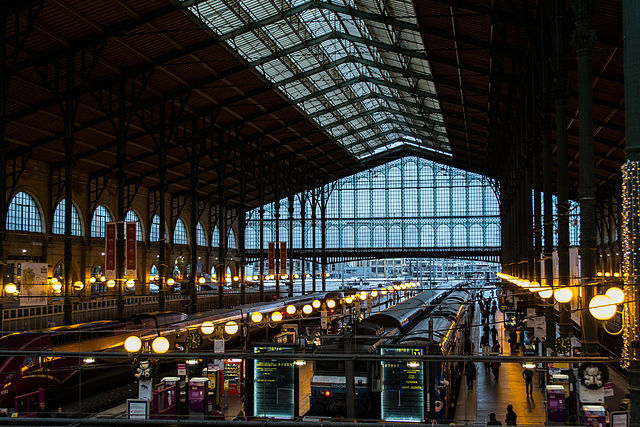
    <summary type="html"><![CDATA[<p><strong><em>A proposal to restructure the Gare du Nord has led to controversy.  The proposed project cost roughly 660 million American dollars (600 million Euro) in the late 2010s. The station is around 400,000 square feet and the plan is to increase it to 1.2 million square feet, which will be able to sustain the 200,000 person increase by 2030. This plan was rejected by well established architects from France, the United States and the United Kingdom. The reasoning behind refusing to take on this massive project was due to the amount of shops that would be added into new space. The 2024 Olympics will be a massive influx of cash flow into the city, besides the boost of money the shops will add, they will also have the passengers be immediately immersed in Paris exiting the train. In spite of all the backlash, the 660 million dollar project is in progress in preparation for the Olympics. </em></strong></p><img src="https://paris.cityandciv.com/files/fullsize/1542b77a96aebd6f705767d4231ca144.jpg" alt="Photograph" /><br/><p>Built in 1865, this train station has been a powerhouse for the 700,000 people it holds at any given time. Jacques Ignace Hittorff, the architect for the building, wanted the building to be beautiful on the exterior, and serve a purpose in the interior. The outside is a Neoclassical style  with 23 female statues on the peaks of the building. They represent each country that you can reach using the station. This is aesthetically pleasing, which is key to any Parisian building built during this time. The interior of the building has a dark industrial look to serve the function, which can withstand hundreds of thousands of people coming in every day. There is a clear contrast from the interior versus the exterior, because each sends a particular message: one is for beauty, while the other is for function.</p><p>The allure of French buildings is the beauty paired with the function. The Gare du Nord is not particularly known as the most beautiful building in Paris. The plan is not just to beautify the place, but to improve its function due to the increase of people, 700,000 to 900,000. The added size is typical for other stations around Paris, for the added shops for consumers to walk around and shop, making the station more of a mall than solely a train station. The Gare du Nord has been often described as dark and chaotic, because the station is meant to serve the everyday commuter and not the consumers that seek high end stores as they walk off the train. Beautifying this station would embody more of Parisian architecture, because it mixes beauty with function throughout the whole building. With added space means added time for the commuter, in turn the function of the station decreases. Choosing the consumer over the commuter is one the main critiques of the architects.</p><p>Paris is a city of uniformity. All of the buildings are beautiful, functional, and aesthetically pleasing. The adjectives to describe the Gare du Nord are of the opposite. The purpose of this station was to be beautiful on the outside and complete function on the inside. The critics of the new project agree that the building's distinct contrast is due to the fact that it is meant to facilitate 700,000 people getting to their destination. Adding shops would purely get in the way of the true purpose. The plan for the Gare du Nord is a battle between the consumer versus the commuter. </p><p>I agree with the architects that the purpose of a train station is to serve the large quantities of commuters going in and out of Paris everyday. The Olympics occurring in 2024 is an incentive to beautify the stations that the visitors will be seeing as they get off the train, but the Olympics ends and the commuters stay. The big takeaway is the continuing conflict within Parisian architecture; is there a way to simultaneously benefit both types of people using the site?</p><p><em><strong><a href="https://paris.cityandciv.com/items/show/53">For more (including 3 images) view the original article</a></strong></em></p>]]></summary>
    <published>2022-04-24T22:10:29+00:00</published>
    <updated>2026-03-04T21:28:19+00:00</updated>
    <link rel="alternate" type="text/html" href="https://paris.cityandciv.com/items/show/53"/>
    <id>https://paris.cityandciv.com/items/show/53</id>
    <author>
      <name>Erika Shinn</name>
    </author>
  </entry>
  <entry>
    <title type="html"><![CDATA[Henri Grégoire: Catholic Priest, Activist, and Defender of Science]]></title>
    <summary type="html"><![CDATA[<p><strong><em>Henri Jean-Baptiste Grégoire was not only a French Roman Catholic priest, but during the French Revolution he became an important figure as a constitutional bishop and a member of the National Convention. He used his position to promote equality by avidly supporting the abolition of human slavery and spreading the word of universal suffrage. Through the years he continued to profess his faith but also advocated for abolishing the monarchy and nationalizing the Catholic church in France. Henri Grégoire also understood the importance of preserving significant scientific artifacts, leading him to become a founding member of The Bureau des longitudes, The Institut de France and The Conservatoire National des Arts et Métiers.</em></strong></p><img src="https://paris.cityandciv.com/files/fullsize/d2ad176827624832179618f735401272.jpg" alt="Portrait of Henri Grégoire" /><br/><p>Born on December 4, 1750, Henri Grégoire grew up in a lower-class family as a son of a tailor in a small village called Vého. He entered into the Jesuit College of Nancy from 1763 to 1768, then went onto the seminary of Metz from 1769 to 1771. After being ordained in 1775, he taught at Pont-à-Mousson, became a member of the clergy at Marimont and then a pastor at Embermenil in 1782. Throughout his education, he distinguished and popularized himself through his tolerance and acceptance of the Jewish community. In 1789, he was elected to the Estates-General and later to the National Convention as a representative of the Clergy, which launched his political career. </p><p>During Grégoire’s lifetime, he spoke about and published pamphlets, letters, and books on equality, promoting a view that was at odds with the National Convention and Clergy. He advocated and fought for the abolition of slavery in France, universal suffrage, freedom of worship, and equal civil rights despite gender, race, and religion. He raised the idea that people of color were equal in all ways to white people, especially intellectually. He not only became an advocate for colored people but also for the Jewish community. As a Catholic priest advocating for the Jewish community, he demanded full naturalization which included political rights. His ideas were radical for the time period, but he continued to defend his beliefs although they clashed with those of the Church. </p><p>Not only was Grégoire a human rights activist, but he understood the importance of preserving scientific and industrial artifacts. In 1794, he established the Conservatoire National Des Arts et Métiers (<em>National Conservatory of Arts and Crafts</em>), which originally intended to offer scientists, inventors, and craftsmen access to a technical education. The school has since become an educational institution for engineering.  Situated next to the Musée des Arts et Métiers (<em>Museum of Arts and Crafts</em>), housed in the abandoned priory of Saint-Martin-des-Champs, it is the world’s first science and technology museum. The museum collection consists of over 80,000 objects and 15,000 drawings, of which only 2,500 objects are on display. In the wake of the French Revolution, Henri Grégoire was a founding member of both Bureau des longitudes (<em>Bureau of Longitudes</em>) and the Institut de France (<em>Institute of France</em>). The Bureau was created to improve nautical navigation, standardize time, and promote geodesy and astronomy research. The Institute houses five academies; the French Academy, the Academy of Humanities, the Academy of Sciences, the Academy of Fine Arts and the Academy of Moral and Political Sciences. Today both the Bureau and Institute serve as educational institutions in Paris. </p><p>Henri Grégoire died in Paris on May 28, 1831, at 80 years old. Above all else, he considered himself as a devout Catholic, but due to his radical views, the clergy was absent from his funeral. In a symbolic gesture, the horses pulling his hearse were freed and students continued to pull the hearse to the cemetery of Montparnasse, with a crowd of about 20,000 following. In 1989, his remains were moved to the Pantheon as a way to celebrate the model of excellence he created by advocating for equal human rights. He is considered to be a man before his time, leaving an inspiring legacy that is still a little known.</p><p><em><strong><a href="https://paris.cityandciv.com/items/show/44">For more (including 5 images) view the original article</a></strong></em></p>]]></summary>
    <published>2019-05-13T07:17:32+00:00</published>
    <updated>2026-03-04T21:28:19+00:00</updated>
    <link rel="alternate" type="text/html" href="https://paris.cityandciv.com/items/show/44"/>
    <id>https://paris.cityandciv.com/items/show/44</id>
    <author>
      <name>Erica Tinnirello</name>
    </author>
  </entry>
</feed>