<?xml version="1.0" encoding="UTF-8"?>
<feed xmlns="http://www.w3.org/2005/Atom">
  <title type="text">Paris City &amp;amp; Civ</title>
  <updated>2026-05-11T18:15:12+00:00</updated>
  <generator uri="http://framework.zend.com" version="1.12.20">Zend_Feed_Writer</generator>
  <link rel="alternate" type="text/html" href="https://paris.cityandciv.com/"/>
  <link rel="self" type="application/atom+xml" href="https://paris.cityandciv.com/items/browse?output=rss2"/>
  <id>https://paris.cityandciv.com/</id>
  <author>
    <name>Paris City &amp;amp; Civ</name>
    <uri>https://paris.cityandciv.com</uri>
  </author>
  <link rel="hub" href="https://pubsubhubbub.appspot.com/"/>
  <entry>
    <title type="html"><![CDATA[Square Montholon: A sanctuary for birds and for me]]></title>
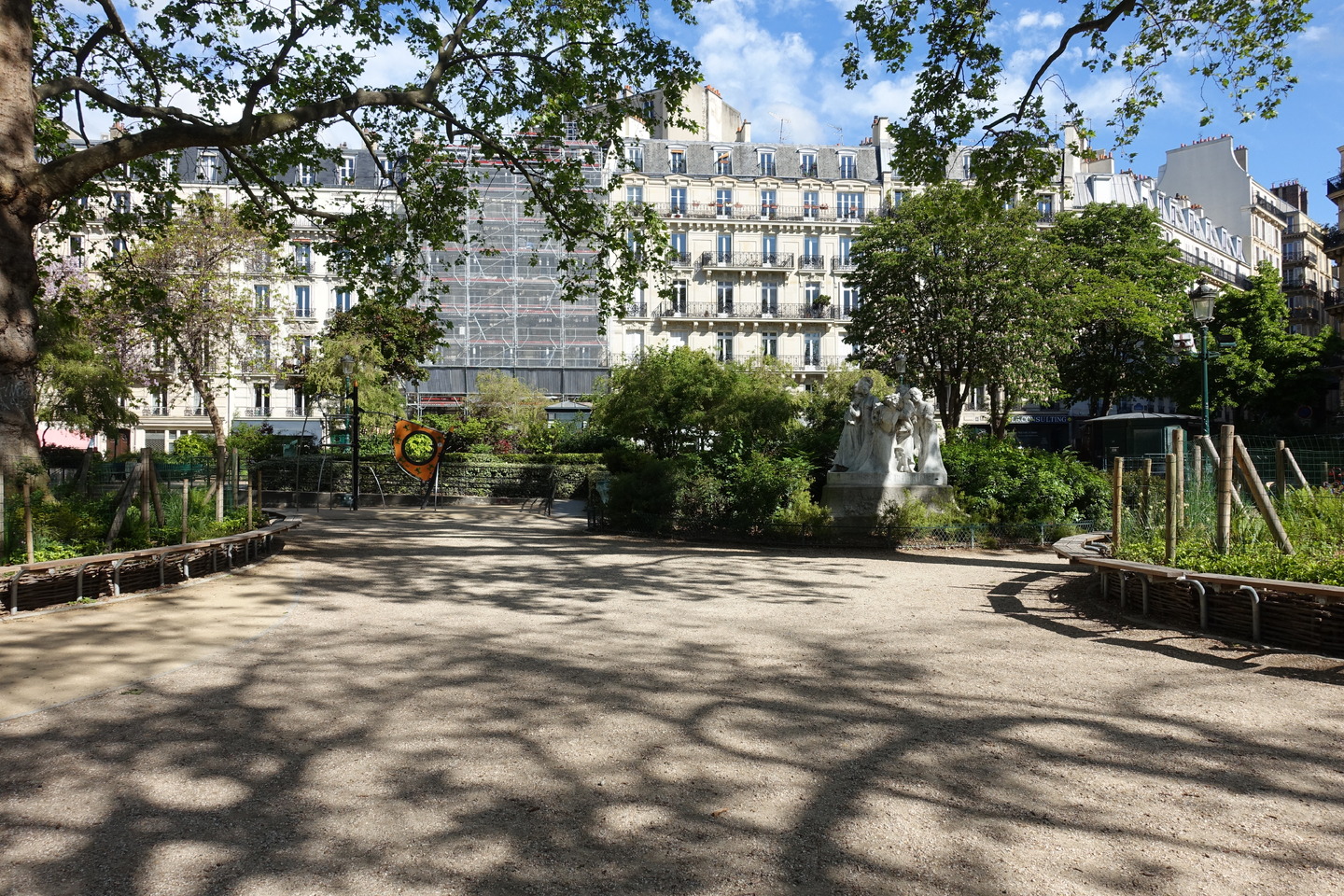
    <summary type="html"><![CDATA[<p><strong><em>Once the garden of an executioner, this square is now a beautiful green space. An ideal spot for gathering, the park houses four young girls, carved from stone yet filled with life.</em></strong></p><img src="https://paris.cityandciv.com/files/fullsize/fedbadd7bbafdc2481efe874a228a043.jpg" alt="Square Montholon @ Paris" /><br/><p>Square Montholon is the largest green space in the 9th arrondissement, measuring 4571 square meters. The space was originally the garden of the estate of Charles-Henri Sanson, an executioner of France, who came from a famous family of executioners operating in Paris from 1688 to 1847. It was transformed into Square Montholon in 1863 and now hosts different bird species and native plants, and emphasizes the importance of wildlife protection. There are two oriental plane trees that are each over a century old and are now over 30 meters tall. The area itself is bordered with entrances near each corner, and Louis-Philippe-style fencing, a Victorian-style of picket fencing used frequently in Parisian gardens.</p><p>While I had done research on Square Montholon before arriving in Paris, it was nothing like I expected it to be. The square was small and intimate but had so much packed into every nook and cranny. As I turned and took in my surroundings, I saw something I didn’t read about or see in the research I did. Towards the center of Square Montholon is a statue, Les Catherinettes by Julien Lovieux, created in 1908, depicting four young women celebrating Saint Catherine’s Day. The holiday, occurring on November 25th, is a day for unmarried women of the age of 25 and above (otherwise known as ‘Catherinettes’) to pray to Saint Catherine to find a husband. While the holiday started in the 10th century, French milliners popularized it in the early 1900s as a way to display extravagant hats, customarily using green and yellow to symbolize wisdom, faith, and success. The tradition has developed and changed over time, but is still celebrated today with over the top, work of art, hats. </p><p>As I looked at the young women before me, I couldn’t help but think about all of the working girls who may have walked through the spot I was standing in. The women in the statue looked so joyful, linking arms and practically falling over each other while walking. Coming to Paris with my own group of girls, I couldn’t help but feel like I knew the ones made of stone. I love that in a city with so much history and so many lives lived, I can find common ground with people who walked the grounds 100 years before me. It felt ironic that what was previously the garden of an executioner had become a beautiful community space—an incredibly bright future for a place with such an interesting and complicated past.</p><p>The square is a peaceful escape from the rest of the city, and even with its small size it is not cramped, or infected with the noise right outside its gates. The sounds from the streets surrounding the park were drowned out by rustling trees and birds chirping, in order to create the quiet space I sat within. The number of colorful birds that I saw above, flying from branch to branch, felt disproportionate to the amount of land available to them. Despite the fact that there was nothing keeping them there, they all seemed settled within the square. I found so much peace within the square, and couldn’t help but be taken by the community I felt sitting in such a beautiful public space. I wondered how many girls sat in that square thinking the same, and listening to the birds.</p><p><em><strong><a href="https://paris.cityandciv.com/items/show/111">For more (including 5 images) view the original article</a></strong></em></p>]]></summary>
    <published>2026-05-09T16:41:26+00:00</published>
    <updated>2026-05-11T18:15:12+00:00</updated>
    <link rel="alternate" type="text/html" href="https://paris.cityandciv.com/items/show/111"/>
    <id>https://paris.cityandciv.com/items/show/111</id>
    <author>
      <name>Elliot Glorioso Rendall</name>
    </author>
  </entry>
  <entry>
    <title type="html"><![CDATA[The Palais Garnier: A Phantom in the Shadows of the City of Light ]]></title>
    <summary type="html"><![CDATA[<p><strong><em>Around every corner you turn in the Paris, a new adventure awaits. This adventure starts in the 9th arrondissement, at the Palais Garnier: one of the most influential opera houses in Parisian history and home to a cunning phantom that still haunts us to this day. </em></strong></p><img src="https://paris.cityandciv.com/files/fullsize/f1c441e498fddf21f0ab830e0a127061.jpg" alt="[Untitled]" /><br/><p>The Palais Garnier in all its grandiosity hides behind a seemingly normal corner in a seemingly normal neighborhood. As you pass a series of high-end cafés and boutiques that were and are still visited by some of the most famous and wealthy visitors to Paris, you would never guess the rich history you are about to encounter. The opera house is breathtaking. As your mind begins to get used to its size and grandeur, you notice its beautiful design. It is ornamented with sculptures and gold décor running towards the top of its enormous architecture. Across the front of the building lies a series of busts representing famous composers like Rousseau and Mozart. If its beauty isn’t enough, its history says it all. There, before your eyes, lies the single influence of one of the most influential works of theatrical art:  "The Phantom of the Opera." </p><p>The Palais was built after Napoleon III survived an assassination attempt at an opera house. This affair led to a competition of 171 people, with the winner being named chief architect for a new opera house with a separate and secure entrance for the Emperor. </p><p>The legend of Phantom of the Opera began with the creation of the Palais. It was built in 1861 and completed in 1874; but not without trouble. There is a body of water in the ground beneath The Palais Garnier that was quite a hassle when it was being built. The architects tried numerous times to pump the water out of the ground, but  were unsuccessful. The water continued to bubble up into the ground of the theater. Finally, to ensure that it would be contained, a water tank was built.</p><p>News of the new theater sitting atop a water tank laid way for the rise of legends. Those rumors particularly interested journalist Gaston Leroux who found them so compelling that he wrote the details into his novel entitled "The Phantom of the Opera." The story follows a deformed composer who holds a love obsession over a chorus singer at the opera house and haunts the rest of the theater as a phantom. The “phantom” is known to live in sewers beneath the opera house, only coming out of them to further his ulterior motives. Leroux published the novel in 1910 and it’s popularity grew to inspire several plays, films, comic strips, and even a ballet, before becoming the beloved musical we know today. </p><p>Furthermore, Leroux incorporated actual life events into his tale. In 1886, the counterweight for a chandelier fell in the Palais and killed a construction worker. The novelist used this event to influence a main plot point in his book. In "The Phantom of the Opera," the phantom drops a chandelier on an audience member, killing him. </p><p>To this day, "The Phantom of the Opera" in its many forms and expressions holds a place in the hearts of theater lovers across the entire world, as well as the place that inspired it all. Rumors of the infamous phantom remain strong, blurring the lines between fiction and reality. One thing does remain consistent between Leroux’s story and real life: the white catfish. To this day a large white catfish lives in the tank and is fed by the opera house staff who say they can see it swimming from time to time. </p><p>As for the Palais itself, the water tank beneath the Palais is still in place. It is used by firefighters of Paris to learn to swim in the dark. When Leroux was on his death bed in 1927, he insisted that the Palais Garnier was indeed haunted by a phantom, further solidifying the chilling affect that his story has had on the world. </p><p><em><strong><a href="https://paris.cityandciv.com/items/show/12">For more (including 6 images) view the original article</a></strong></em></p>]]></summary>
    <published>2019-05-03T02:17:05+00:00</published>
    <updated>2026-03-04T21:28:17+00:00</updated>
    <link rel="alternate" type="text/html" href="https://paris.cityandciv.com/items/show/12"/>
    <id>https://paris.cityandciv.com/items/show/12</id>
    <author>
      <name>Joycelynn Wiggins </name>
    </author>
  </entry>
  <entry>
    <title type="html"><![CDATA[Cimetière du Montparnasse: Colorful Stories of the Dead]]></title>
    <summary type="html"><![CDATA[<p><strong><em>Cimetiere du Montparnasse is the perfect forum to interact with some of the characterful deceased residents of Paris;  don’t forget your metro ticket and lipstick!</p></strong></p><img src="https://paris.cityandciv.com/files/fullsize/92149e2c91bd08a5c8d474f319d57225.jpg" alt="Man Ray Grave: Cemetery of Montparnasse" /><br/><p>	The bustling city of Paris is chock full of cemeteries. More and more grave markers appear as the city’s extensive history continues to grow. Located in a neighborhood with profound artistic significance, Cimetière du Montparnasse is home to a rich variety of creative minds. From the outside, the cemetery lies waiting behind the walls that hide it from the street. Foliage covers the expanse of the wall. When visiting in greener months, the beauty of both life and death can be observed at Cimetière du Montparnasse. Maps at the entrances establish the cemetery as a well visited spot, showing patrons the approximate locations of the graves belonging to those they wish to find. Little cobblestone pathways weave between grave sites and intersect with paved roads that enhance ease of navigation. There is no rhyme or rhythm to the staggered arrangement of tombs down each row. New graves are juxtaposed with old and all are unique, with special flares to commemorate the souls that reside there. The cemetery is crowded with individual gems, and only a few of its many treasures will be noted here. </p><p>First is both the grave site and works of sculptor Constantin Brancusi. Brancusi certainly left his mark on this infamous Parisian cemetery. The sculptor is buried in Cimetiere du Montparnasse alongside Alexandre Istrati and Natalia Dumitresco in a very simplistic and unpretentious grave. Brancusi’s body, however, is not the only item of his that lies there. The grave is located a short distance away from one of his earlier sculptures from 1907, ‘The Kiss’. The story behind this beautiful work makes it all the more interesting. Brancusi made the sculpture, which was chosen by his friend, the lover of Tania Rachevskaia, to be placed on her grave in memorial. It was their tragic love affair that led to her suicide in 1908. ‘The Kiss’ was the third sculpture of its kind in a series. Unfortunately visitors today, can no longer view the sculpture which has been unceremoniously surrounded by wooden boards. The reasoning for this is still widely unknown, but the best guesses point towards either restoration or family motives. Either way, thanks to his grave, Brancusi’s presence remains.</p><p>Another interesting member of Cimetiere du Montparnasse is famous photographer Man Ray. Adorning Man Ray’s grave is the quote “unconcerned, but not indifferent… Love Juliet”, from the woman who would be soon to join him in resting there, his wife. The quote alludes to his unique character and provocative works. His muse, ‘Kiki de Montparnasse’, also resides at the cemetery. Kiki made an appearance modeling in many of Man Ray’s works. As a legendary figure of the Montparnasse neighborhood, it is appropriate that she be buried there as well. Aside from serving as Man Ray’s muse and a model for many other artists Kiki was a singer, socialite, and actress. Ernest Hemingway claimed that Kiki “dominated the era of Montparnasse more than Queen Victoria ever dominated the Victorian era”. </p><p>Cimetière du Montparnasse is also home to the grave site of Jean Paul Sartre. Jean Paul Sartre was a very well-known philosopher. He is best recognized for his work in developing the concept of existentialism. There are two unique things about this grave that Sartre shares with Simone de Beauvoir, author of The Second Sex and an existentialist herself. The grave is often littered with Metro tickets weighted down by pebbles of various sizes and lipstick stains. It's a bit of a stretch from flowers, but there is a reasoning behind it. While the reasoning is not completely known or understood,  it is assumed that the Metro ticket tradition is derived from Sartre’s support of a Chinese Maoist group who gave free tickets out when prices shot up. Another theory relates the tickets to the Boulevard Voltaire riots. The brightly tinted lip marks smacked upon the face of the headstone arise from both the affection of Sartre’s fans as well as the recognition of his and Simone de Beauvoir’s open relationship. </p><p>The rich history of Cimetiere du Montparnasse does not end here. If interested in learning more about the cemetery’s contents, visit the recommended links below to see a full list of the cemetery’s inhabitants as well as a map. </p><p><em><strong><a href="https://paris.cityandciv.com/items/show/7">For more (including 6 images) view the original article</a></strong></em></p>]]></summary>
    <published>2019-04-24T05:50:52+00:00</published>
    <updated>2026-03-04T21:28:17+00:00</updated>
    <link rel="alternate" type="text/html" href="https://paris.cityandciv.com/items/show/7"/>
    <id>https://paris.cityandciv.com/items/show/7</id>
    <author>
      <name>Danielle Cooke</name>
    </author>
  </entry>
</feed>
